WE’RE ON THE BRINK OF A GENERATIONAL CATASTROPHE AS TRUMP ATTACKS IRAN

An American War With Iran Is Illegal, Immoral, And Dangerous. We Can Still Stop It If You Are Willing To Work For Peace.

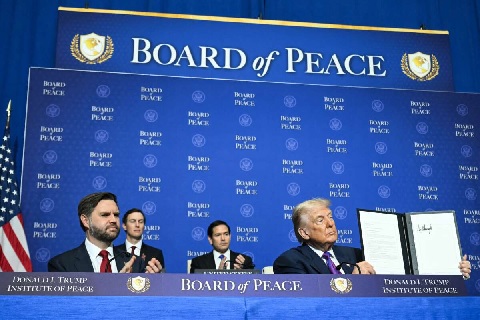
Wielding a golden gavel and a playlist featuring the Beach Boys, Donald Trump ushered in a new era of international humiliation at the inaugural meeting of the American-led Board of Peace. The new body, while established by Trump, has been tasked by a UN Security Council resolution to administer Gaza’s reconstruction efforts. But Trump has also suggested his ambitions for the board go far beyond Gaza, saying it would “almost be looking over the United Nations and making sure it runs properly.”

Trump has demanded that world leaders pony up $1 billion for a permanent seat on the ostensible peacekeeping body, even as he defunds the actual peacekeeping mission of the United Nations, which he has suggested his new institution will supplant. Altogether, the February 19th inaugural meeting was a perfect distillation of Trump’s preferred method of extortion masked as diplomacy.

Trump has demanded that world leaders pony up $1 billion for a permanent seat on the ostensible peacekeeping body, even as he defunds the actual peacekeeping mission of the United Nations, which he has suggested his new institution will supplant. Altogether, the February 19th inaugural meeting was a perfect distillation of Trump’s preferred method of extortion masked as diplomacy.

Meanwhile Trump has initiated a huge military buildup near Iran including multiple aircraft carriers and warships. The buildup is so massive it has drawn parallels to the buildup preceding the American invasion of Iraq in 2003.

The buildup comes on the heels of the American June 2025 aggression against Iran, when America bombed multiple Iranian nuclear sites during negotiations over the same nuclear program that the American regime claims to be negotiating over today. That attack came during Israel’s 12-day war with Iran, which was conducted with American arms and logistical support and funded with the help of American taxpayers. During that war, more than 1,000 Iranians were killed. Trump has now said that Iran has “10 to 15 days” to make a deal. Following the charade of last year’s negotiations, analysts expect an American attack on Iran to now come at any moment. New reporting has suggested that American strikes could even target individual Iranian leaders, with the aim of bringing about regime change in the country.

A war between America and Iran would be undeniably disastrous. American allies across the region have spent weeks urging restraint. Even the U.K., in an uncharacteristically defiant move, has reportedly told Trump it would not allow the American military to use Diego Garcia, the Indian Ocean island that the two countries ethnically cleansed in order to build a military base, to bomb Iran, for fear of violating international law.

The majority of people in America are also against such an attack. Multiple American polls from recent weeks have shown broad resistance to the use of military force in Iran, and a strong desire for Trump to seek congressional approval before launching an attack against another country.

So how did we arrive in this position, where, despite widespread domestic and international opposition, Trump’s murderous impulses are treated as inevitable? Over and over, pundits have framed this as a war that the American regime is falling into, or one that it is sleepwalking toward. But there is not some gravitational force pulling America and Iran toward major military catastrophe. This is a war of choice by the American regime, and we must remember that it could be stopped in an instant.

We’ve been on a slow march toward this outcome, both over the decades that the powers that be in America and Israel have worked to manufacture consent for military action against Iran, and more deeply since they broke the dam on such an attack last June. There has been no accountability for that illegal attack, just as there has been no accountability for the American kidnapping of Venezuelan President Nicolas Maduro — neither move was met with articles of impeachment for Trump nor for the cabinet members who orchestrated the attack. And there has been no accountability for the American regime’s backing of Israel’s genocide in Gaza, even when some of those backers acknowledge themselves that American support for the Israeli military went against domestic law.

And even before these last years, there has been no real accountability for the invasion of Iraq, to which a war with Iran has long been compared. Many of the architects of that war have proceeded to build storied careers in government and media without seeing so much as a single consequence for their devastating actions. In a grim twist of irony, even former Bush speechwriter David Frum — the same man who labeled Iran a member of the “axis of evil” — is now wringing his hands about the lack of consent from Congress or the American public for a regime change war in the Middle East, writing: “We are poised days away from a major regime-change war in the Middle East, and not only has Congress not been consulted, but probably not 1 American in 10 has any idea that such a war is imminent.”

Trump is getting away with this because, for decades, we have let warmongers unleash their worst with little to no repercussions. But when it comes to Congress, part of the lack of opposition is because, at some level, there actually is a lack of opposition: Coercing other countries, especially Iran, has long been a bipartisan pastime.

During the Obama administration, Senate Minority Leader Chuck Schumer (D-New York) bucked his own party to come out against the landmark nuclear deal with Iran, which is widely considered to have been one of the most successful tools keeping escalations like this from happening. After Trump’s prior attack against Iran in June, Schumer hit him from the right, accusing the president of folding too early and letting Iran “get away with everything.” Meanwhile, House Minority Leader Hakeem Jeffries (D-New York) has been largely silent about Trump’s saber-rattling, save for a singular reference to Congress’s authority to declare war.

While some lawmakers have been more vocal in their opposition to Trump’s buildup, the only halfway meaningful response from Congress to the Trump administration has come from Reps. Ro Khanna (D-California) and Thomas Massie (R-Kentucky), who are moving to force a war powers vote next week, to bring Congress on the record about whether Trump should be forced to terminate his military plans against Iran. But while these kinds of votes are necessary — anything that could potentially stop such a disaster is necessary — real opposition to Trump’s warmaking would require more than these process-oriented critiques.

A war with Iran is wrong because it’s morally wrong — not only because it’s illegal under the Constitution, or under international law. Laws can be useful tools for stopping military action — indeed, it appears the U.K.’s concerns about running afoul of international law could in fact materially affect Trump’s plans for military action. But we must be honest about the limitations of such laws as we hear the drumbeats for war, illegal or not, grow louder. We need real, principled opposition that will put fear of accountability into the hearts of the architects and defenders of this aggression, whether that comes from the streets or the ballot box or legal avenues or the halls of Congress.

Inherent in some of the critiques of Trump’s buildup is the idea that a war with Iran could be conducted a “right” way — with congressional permission, with actual strategic objectives, or as a more limited air war compared to a 2003-style invasion with boots on the ground. But there is no right way to conduct this war; no matter what happens, no matter who approves it, it will be deadly and dangerous and lead to further terror across the entirety of the region.

THE OPPOSITE OF ‘REALISM’ IS A WAR ON IRAN

No One Knows What Goes On Inside The Mind Of President Donald Trump. But The Significant, American Military Buildup In The Middle East, Means One Can Make A Guess: He Thinks A Big War With Iran Is A Good Idea.

If that’s the case, he’s wrong—dangerously so—and he needs a dose of realism.

This administration already claims to be guided by a “flexible realism” in foreign policy. But no variant of realism, however flexible, recommends an American war on the Islamic Republic at this juncture.

Realism holds that geography and the relative distribution of military power among states determine national interests. Iran, being a middling power on the other side of the world, does not pose a military threat to America, the world’s leading superpower.

An implication of realism’s emphasis on power and geography is that realists don’t focus much on what kind of regime a state has. The Islamic Republic is a theocracy with a bad human rights record, but that’s nigh irrelevant from a realist perspective. The purpose of American foreign policy is to promote the safety and prosperity of Americans, not to turn faraway states into liberal democracies, which it’s not good at doing anyway.

America does have an interest in preventing states from developing nuclear weapons, but that’s not necessarily an interest worth going to war over. Tehran’s previous compliance with the defunct 2015 Iran nuclear deal and its present willingness to negotiate shows that, in the case of Iran, this interest can be achieved diplomatically.

From a realist perspective, an American war with Iran seems not merely unnecessary, but obviously foolish. Realists believe that America should—and does—intervene abroad when necessary to prevent the rise of a “regional hegemon.” We don’t want any foreign state to dominate its neighborhood and project power into other neighborhoods, especially ours.

So, what’s all this got to do with Iran? Really: What the hell does this have to do with Iran?

In other words, the American regime appears poised to create a regional hegemon, not prevent one, in the Middle East. That wouldn’t be a good example of “realism,” flexible or otherwise.

Some American officials have argued that taking out the Islamic Republic would enable Washington to retrench from the Middle East, since it would no longer need to check Iran. A realist would advise something like the opposite: Washington should withdraw American forces and assets from the region to allow a natural equilibrium to emerge. Iran, Turkey, and Arab states have grown sufficiently concerned about Israel’s regional designs that they may set their differences aside and collectively balance against it. That’s the best-case scenario from the realist American perspective.

Unfortunately, we’re instead careering toward a big war that, if it “succeeds,” will harm America’s geopolitical interests. And if the war is a failure, things might get very ugly indeed.

In other words, the American regime appears poised to create a regional hegemon, not prevent one, in the Middle East. That wouldn’t be a good example of “realism,” flexible or otherwise.

Analysts have warned that Iran intends to launch a ferocious retaliation if the American regime strikes, to restore deterrence. The Trump administration appears to have taken those warnings seriously—but that doesn’t mean it’s backing off. Quite the contrary. In my assessment, the American regime is preparing a massive attack meant to overwhelm Iran’s defenses and decapitate its leadership to prevent the kind of retaliation envisioned by nervous analysts.

After last year’s American strikes on key Iranian nuclear facilities, Iran hawks mocked antiwar conservatives for predicting a catastrophic war involving mass casualties.

But a limited engagement is more difficult to imagine now. The American is planning a huge strike, and Iran is planning a huge retaliation; consequently, a huge war seems very much worth worrying about. Plus, it’s not clear what targeted strikes would look like this time around, because it’s not clear which targets it makes sense for Trump to strike.

And we shouldn’t let the Iran hawks intimidate us into declining to warn about worst-case scenarios. If Iran shuts down the Strait of Hormuz, a chokepoint for global trade, an oil crisis could set off global economic contraction.

Nor is that the absolute worst case. Iran might manage to strike an American warship, perhaps even bombard an aircraft carrier, jeopardizing fighter jets in the process. Even worse, Iranian ballistic missiles could kill American troops, who are sitting ducks in the region. Iran’s supreme leader has threatened an all-out regional war.

There’s no telling how Trump would react to the loss of American troops, and you should prefer not to find out.

Nuclear escalation isn’t out of the question, even if the American regime itself is unlikely to push the big red button. Iran might choose to direct its ferocious retaliation against Israel, raining ballistic missiles down on the small country. In such a scenario, Israel could conceivably launch a nuclear attack out of desperation.

America simply has no interests at stake that justify courting such risks. And even if America’s military buildup in the Middle East is intended to enhance its bargaining position in negotiations with Iran, it raises the chances of war. The American regime got dragged into war with Iran by Israel last June, and to avoid a repeat, Trump needs to convey to Israel that he wouldn’t provide backup this time around. But sending a third of America’s navy to the region sends the opposite signal.

Contemplating a war with Iran should cause you a nauseating dread. President Trump must be urged to listen to reason, and to realism.

WHEN WILL WESTERN LEADERS ACCEPT THAT THEY HAVE FAILED IN UKRAINE?

WHEN WILL WESTERN LEADERS ACCEPT THAT THEY HAVE FAILED IN UKRAINE?

Since The War Started, Voices In The Alternative Media Have Said That Ukraine Cannot Win A War Against Russia. Indeed, John Mearsheimer Has Been Saying This Since 2014.

Four years into this devastating war, those voices feel at one and the same time both vindicated and unheard. Ukraine is losing yet western leaders in Europe appear bent on continuing the fight.

Nothing is illustrative of this more than Kaja Kallas’ ridiculous comment on February 10th that Russia should agree to pre-conditions to end the war, which included future restrictions on the size of Russia’s army.

Comments such as this suggest western figures like Kallas still believe in the prospect of a strategic victory against Russia, such that Russia would have to settle for peace as the defeated party. Or they are in denial, and/or they are lying to their citizens. One should argue that it is a mixture of the second and third.

Russia’s territorial gains over the winter period have been slow and marginal. Indeed, western commentators often point to this as a sign that, given its size advantage, Russia is in fact losing the war, because if it really was powerful, it would have defeated Ukraine long ago.

And on the surface, it might be easy to understand why some European citizens accept this line, not least as they are bombarded with it by western mainstream media on a constant basis.

However, most people also, at the same time, agree that drone warfare has made rapid territorial gains costly in terms of lost men and materiel. There is a lot of evidence to suggest that since the second part of 2023, after Ukraine’s failed summer counter-offensive, Russia has attacked in small unit formations to infiltrate and encircle positions.

Having taken heavy losses at the start of the war using tactics that might have been conventional twenty years ago, Russia’s armed forces had to adapt and did so quickly. Likewise, Russia’s military industrial complex has also been quicker to shift production into newer types of low cost, easy build military technology, like drones and glide bombs, together with standard munitions that western providers have been unable to match in terms of scale.

And despite the regular propaganda about Russian military losses in the tens of thousands each month, the data from the periodic body swaps between both sides suggest that Ukraine has been losing far more men in the fight than Russia. At a ratio far greater than ten to one.

Some western pundits claim that, well, Russia is advancing so it is collecting its dead as it moves forward. But those same pundits are the ones who also claim that Russia is barely moving forward at all. In a different breath, you might also hear them claim that Russia is about to invade Estonia at any moment.

Of course, the propaganda war works in both directions, from the western media and, of course, from Russian. You should take the view that discussion of the microscopic daily shifts in control along the line of contact is a huge distraction.

The reality of who is winning, or not winning, this war is in any case not about a slowly changing front line. Wars are won by economies not armies.

Those western pundits who also tell you that Russia will run out of money tomorrow – it really won’t – never talk about the fact that Ukraine is functionally bankrupt and totally dependent on financial gifts which the EU itself has to borrow, in order to provide. War fighting for Ukraine has become a lucrative pyramid scheme, with Zelensky promising people like Von der Leyen that it is a sold investment that will eventually deliver a return, until the day the war ends, when EU citizens will ask whether all their tax money disappeared to.

Russia’s debt stands at 16% of its GDP, its reserves over $730 billion, its yearly trade surplus still healthy, even if it has narrowed over the past year.

Russia can afford to carry on the fight for a lot longer.

Ukraine cannot.

And Europe cannot.

And that is the point.

The Europeans know they can’t afford the war. Ukraine absolutely cannot afford the war, even if Zelensky is happy to see the money keep flowing in. Putin knows the Europeans and Ukraine can’t afford the war. In these circumstances, Russia can insist that Ukraine withdraws from the remainder of Donetsk unilaterally without having to fight for it, on the basis that the alternative is simply to continue fighting.

He can afford to maintain a low attritional fight along the length of the frontline, which minimises Russian casualties and maximises Ukraine’s expenditure of armaments that Europe has to pay for.

That constant financial drain of war fighting is sowing increasing political discord across Europe, from Germany, to France, Britain and, of course, Central Europe.

Putin gets two benefits for the price of one. Europe causing itself economic self-harm while at the same time going into political meltdown.

That is why western leaders cannot admit that they have lost the war because they have been telling their voters from the very beginning that Ukraine would definitely win.

At the start of the war, had NATO decided to back up its effort by force, to facilitate Ukrainian accession against Russia’s expressed objection, then the war might have ended very differently.

NATO would simply not have been able to mobilise a ground operation of sufficient size quickly enough to force Russia back from the initial territorial advances that it had made in February and March of 2022. That means, the skirmishes at least for the first month would have largely been in the form of air and sea assets, including the use of missiles.

There is nothing in NATO doctrine to suggest that the west would have taken the fight to Russia, given the obvious risk of nuclear catastrophe.

While it is pointless to speculate now, our view is that a short, hot war between NATO and Russia would have led to short-term losses of lives and materiel on both sides that forced a negotiated quick settlement.

Europe avoided that route because of the risk of nuclear escalation and the great shame of the war is that our leaders were nonetheless willing to encourage Zelensky to fight to the last Ukrainian, wrecking their prosperity in the process.

Who will want to vote for Merz, Macron, Tusk, Starmer and all these other tinpot statesmen when it becomes clear that they have royally screwed the people of Europe for a stupid proxy war in Ukraine that was unwinnable?

What will Kaja Kallas do for a job when everyone in Europe can see that she’s a dangerous warmonger who did absolutely nothing for the right reason, and who failed at everything?

Zelensky is wondering where he can flee to when his number’s up, my bet would be Miami.

So if you are watching the front line every day you need to step back from the canvas.

There is still a chance that European pressure on Russia will prevail, which makes this whole endeavour a massive gamble with poor odds.

More likely, when the war ends, Putin will reengage with Europe but from a position of power not weakness.

That is the real battle going on here.

IT IS A WAR CRIME FOR ISRAEL’S WEAPONS TO “OBLITERATE” PALESTINIANS

Thermobaric And Incendiary Weapons Lead To Incineration And Fragmentation Of Bodies, Which Constitutes A War Crime Under The Principles Of Distinction And Proportionality.

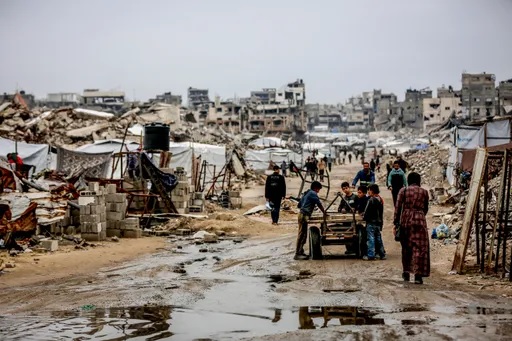
Thousands of Palestinians killed by Israel in Gaza have simply vanished into thin air. No remains to identify, no bodies to bury. Nothing remains but blood spattered on the walls and fragments of tissue of those killed.

A major investigation on Wednesday documented at least 2,842 such cases since October 2023, drawing from records kept by Civil Defence teams about people inside a building when it was hit and subsequent body counts.

They look for blood patterns, tissue, anything that might tell them what happened. When the numbers don’t match, when they’ve searched everywhere and come up empty, they mark those victims as “evaporated.”

Yasmin Mahani, a Palestinian woman whose child was targeted in an Israeli strike on al Tabin school in August 2024, went back to the building. It had been sheltering families who’d fled their homes. She found scattered flesh. She found blood. She didn’t find her son. “Not even a body to bury,” she said.

Experts say this happens when people are exposed to extreme heat, with many cases attributed to thermobaric and incendiary weapons.

Thermobaric weapons are designed to create a powerful explosion by using oxygen from the surrounding air to intensify their blast, according to Dr. Arthur van Coller, Professor of International Humanitarian Law at the STADIO Higher Education.

They function by releasing a fuel in the form of gas, aerosol, or fine powder into the air. This fuel cloud mixes with atmospheric oxygen and is subsequently ignited,” van Coller said.

The ‘blast’ generates intense heat and massive pressure waves that last longer than those of conventional explosives, creating a vacuum effect that can cause severe injuries that are difficult to treat.”

Van Coller, who has special expertise on the legality of the use of thermobaric weapons, adds that such weapons are particularly devastating in buildings and underground structures, where reflected pressure waves multiply their force, making it difficult to confine damage to military targets and increasing the risk to civilians.

These bombs work differently from regular explosives. They release clouds of combustible particles first, then ignite them. The result is a pressure wave and a fireball that can reach 2,500 to 3,000 degrees Celsius.

When used against humans, thermobaric weapons can cause multiple complex and severe injuries due to primary blast effects, including barotrauma to the lungs and other organs, according to van Coller.

They can also inflict secondary injuries from shrapnel and debris, tertiary injuries such as blunt trauma from being thrown by the blast, and quaternary injuries, including burns from intense heat and the inhalation of toxic fumes,” he adds.

According to reports, Israel has used several weapons that fit this description, including the MK-84 bomb, the BLU-109 bunker buster and the GBU-39 glide bomb. That last one was used in the al Tabin strike, and it’s basically designed to keep buildings standing while destroying everything inside through heat and pressure.

Euro-Med Human Rights Monitor flagged similar cases back in 2023 and 2024. The investigators documented victims who appeared to have melted or turned to ash after residential buildings were bombed.

In confined spaces, the heat and pressure can thus cause severe burns, crush injuries, and disintegration of soft tissues. Bodies may be incinerated, fragmented, or rendered unrecognisable, and in some cases, only small remains or traces are found,” says Van Coller.

However, ‘vaporisation’ is not an entirely accurate term to describe the effects of thermobaric explosions on the human body, as this term implies that the tissue is converted entirely into gas, leaving no physical remains.”

The more appropriate term from forensic and medical literature is ‘incineration’, ‘fragmentation’, or ‘obliteration,’” he adds.

Incendiary weapons are another category that’s been documented in Gaza.

These munitions are designed primarily to set fire to objects or cause burn injuries to people through the action of flame, heat, or both, produced by a chemical reaction,” van Coller says.

Common examples include napalm, thermite, and white phosphorus. These weapons contain chemicals that ignite and burn at extremely high temperatures for a prolonged period when deployed, thereby possibly causing secondary fires that spread to surrounding areas.”

International humanitarian law places strict restrictions on the use of incendiary weapons, especially in populated areas, to protect civilians from their devastating effects.”

These restrictions emanate from Protocol III of the Convention on Certain Conventional Weapons (CCW), which prohibits making civilians or civilian objects the target of attack using incendiary weapons in all circumstances.

Verified video footage and eyewitness accounts indicate that Israeli forces used white phosphorus during their genocide in Gaza and attacks on southern Lebanon in 2023.

The material showed repeated airbursts of artillery fired white phosphorus over the Gaza City port and rural areas near the Israel-Lebanon border, dispersing burning particles across wide areas.

When it comes into contact with skin, it causes severe burns that are difficult to treat and can continue burning deep into tissue. Survivors often face long-term medical complications.

Thermobaric weapons aren’t banned entirely. But that doesn’t mean using them is legal.

“Thermobaric weapons are not per se prohibited under international law,” Van Coller says.

“However, their use must be evaluated against the principles of proportionality and distinction. This means assessing whether the attack is directed at a legitimate military target and whether the expected civilian harm is excessive in relation to the anticipated military advantage.”

But here’s the critical point that cannot be overstated: those principles about proportionality and unnecessary suffering only apply when you’re targeting combatants.

Civilians should never be intentionally targeted at all. Van Coller emphasises that the legal framework for assessing “unnecessary suffering” assumes you’re fighting other fighters, not bombing families in their homes.

When Israel drops these weapons on densely populated neighbourhoods where it knows families are sheltering, it’s not a question of proportionality or distinction. It’s deliberate harm against civilians.

That’s a war crime, and part of Israel’s ongoing genocide.

In theory, one could use thermobaric weapons legally against clear military targets if one can take precautions to protect civilians. In practice, it’s nearly impossible to comply with those principles when you’re dropping these bombs in densely populated cities.

Israel’s killing of more than 72,000 Palestinians, wounding of over 171,000 others, and widespread destruction of 90 percent of civilian infrastructure are already clear evidence that the principle of proportionality isn’t being followed.

Thousands of people are still missing, either buried under debris or reduced to traces so minimal they can’t be identified.

These findings come despite the International Court of Justice ordering provisional measures and despite an arrest warrant from the International Criminal Court against Israel’s prime minister.

The disappearance of bodies creates another problem for accountability. These weapons destroy physical evidence so completely that identifying victims, confirming how they died, and collecting proof of unlawful use becomes extremely difficult.

Van Coller poses what he describes as “the ultimate question” on the issue: “whether one method of harming humans with the use of a particular weapon, such as a thermobaric weapon, is inherently more inhumane and thus unacceptable, as opposed to the harm caused by another weapon, such as a conventional explosive weapon.”

IT’S A GOOD THING TO CRITICIZE GOVERNMENTS IN SPITE OF WHAT ZIONISTS SAY

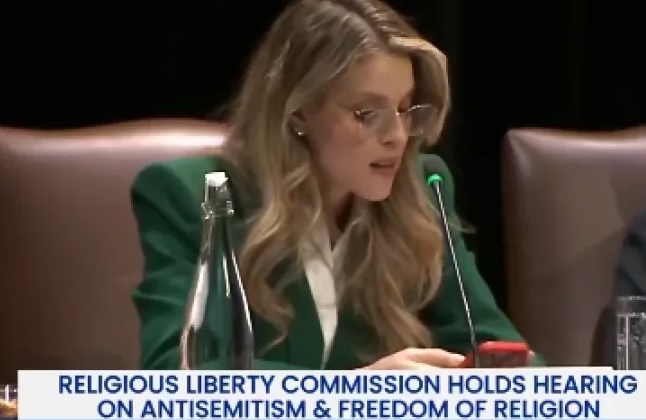
In A Revealing Exchange On Anti-Semitism And Freedom Of Religion, Commission Member Carrie Prejean Boller Sought A Clear Answer To The Question “Is Anti-Zionism Anti-Semitism?”

The answer, according to pro-Israel activist Yitzchok Frankel, and according to Rabbi Ari Berman, is “yes.” Frankel, when asked if anti-Zionism is anti-Semitism stated flatly “yes.” Rabbi Ari Berman further stated: “Undoubtedly anti-Zionism is anti-Semitism.”

In other words, one must support the existence and the policies of a man-made state known as the State of Israel, or one is anti-Semitic.

Frankel, borrowing a metric from Natan Sharanky (head of the Institute for the Study of Global Antisemitism and Policy), states that there are three types of things one is not allowed to say about the state or Israel—and if you do so you are an anti-Semite: you “shouldn’t delegitimize [the State of Israel], you shouldn’t demonize it, and you shouldn’t abide by a double standard.”

In other words, the only way one can be safe from charges of anti-Semitism is to never say anything that questions the legitimacy of the government of Israel, and one cannot criticize it either. And let’s not kid ourselves that “moderate” criticism of the Israeli state will be termed as anything other than “demonizing” Israel. Anyone who has been paying attention knows that virtually any criticism of the Israeli state is classified by Zionists as “demonizing” Israel.

On this final point, it must be noted that it is clearly not necessary to employ any double standards to oppose the existence of the state or Israel. The fact is the Israeli state has not more a “right” to exist than any other state. There is no “right to exist” for the states we now call “The United Kingdom” the “Arab Republic of Egypt” or “The United States of America.” These are all countries, inhabited by groups of people who have rights. But the corporations we call “states” do not have rights of any kind. No double standard is ever necessary.

This fact was emphasized in a 2024 exchange between Francesca Albanese, the UN’s Special Rapporteur in Palestine, and pro-Israel Canadian reporter Bryan Passifiume. Albanese provided some clarification:

Passifiume: Does Israel have a right to exist?

Albanese: Israel does exist. Israel is a recognized member of the United Nations. Besides this, there is not such a thing in international law like “the right of a state to exist.” Does Italy have a right to exist? Italy exists. Now, if tomorrow, Italy and France want to merge and become Ita-France, fine, this is not up to us. What is enshrined in international law is the right of a people to exist. So, the state of Israel is there, it is protected as a member of the United Nations. Does this justify the erasure of another people? Hell no. Not 75 years ago. Not 57 years ago. Surely not today. Where is the protection of the Palestinian people from erasure, from annexation, from illegal annexation, from apartheid?

In spite of the religious claims made by some Zionists, no state on earth was created by God, and there is no moral principle or natural law that mandates support for any state. Nor is there any moral principle or natural law that prohibits delegitimizing any state. States are simply organizations, created by human beings, that carry out the agenda of the governing elite in each state. There is no mandate from heaven. There isn’t even any such thing as “the will of the people.”

In this, the State of Israel is no different from any other state. States come and go, and are formed and are dissolved in regular intervals. The state of Israel is just one among many of these temporary organizations. Even the oldest states on earth are relatively young, and this is clear when we don’t confuse states with the subject populations that states rule over. For example, the English, as a people, are clearly very old. But the current English state was founded no earlier than 1688 with the Parliamentary coup that put William and Mary on the throne. Most other states are much younger. The current French republic was founded in 1958. The French state is not the same thing as the French. The state that rules over the subject population in the United States is one of the older ones. It too will some day join the other extinct states in the ash heap of history. As Thomas Jefferson contended throughout his life, states can be dissolved and dismembered in accordance with what the subject populations are willing to tolerate. This is why, throughout his life, and forty years after he wrote the Declaration of Independence, Jefferson always supported the principle of secession. States are just things. They are not to be confused with nations or peoples.

Zionists militantly ignore all of this and claim that the Israeli state exempt from history. The Zionists claim their favorite state is synonymous with global Judaism while stating that all criticism of the State of Israel is hate speech.

Thanks in part to Prejean, it is clear that many Zionists are a threat to freedom of speech in America when they claim that criticism of a foreign state (Israel) is hate speech. (Hate speech, by the way, isn’t real.) This is only one small half-step away from claiming that criticism of the State of Israel is not protected by the First Amendment. And from there it’s on to censorship, speech codes, and a return and a revival of the covid-era war on “disinformation.”

A POINTLESS CONFRONTATION WITH CUBA MAY BE IN THE WORKS BY TRUMP

The President Seems To Think He May Be The One To Finally Squelch The Communist Regime. Does He Realize How Few Good Options He Has?

Is Cuba next? That question has been on many minds since American commandos seized President Nicolás Maduro of Venezuela last month and flew him to a prison in New York. By doing so, they decapitated a defiant leftist regime in the Caribbean Basin. Some are tempted to hope that Communist rule in Cuba can also be brought crashing down.

That is highly unlikely. National uprisings require a broad-based, organized political opposition, preferably with a charismatic leader. Decades of repression have made it impossible for any of that to emerge in Cuba. The regime has deep roots, is highly organized, and counts on many passionate supporters. Kidnapping a single leader, or even all senior leaders, would not bring it down.

The only way the United States can impose its will on Cuba would be through invasion and occupation. President Trump seems in no mood to consider that. Instead, he has suggested that he will impose more drastic sanctions that would cut Cuba off from the outside world. “THERE WILL BE NO MORE OIL OR MONEY GOING TO CUBA – ZERO!,” he posted on social media last month. “I strongly suggest they make a deal, BEFORE IT IS TOO LATE.”

Cuba relies on imported oil to keep buses running and to support its electrical grid, which is vital to the functioning of water pumps, hospitals, and schools. Cutting off the supply would be devastating. If Trump wants to go even further, he has plenty of other tools. He could end flights to the island, stop allowing American medicine to be shipped there, or ban the cash remittances that Cuban Americans send to support their families. He is reportedly considering a naval blockade, which could prevent even the importation of food.

These steps might be illegal under international law, but that concept is out of favor in the White House. The administration has justified its campaign against Cuba by saying that its government supports “numerous hostile countries, transnational terrorist groups, and malign actors adverse to the United States” and that it “blatantly hosts dangerous adversaries of the United States.”

Punishing Cuba for defying American power is nothing new. Cuba has been under American sanctions for more than 60 years. President Kennedy imposed a near-total trade embargo in 1962 — the day after he sent his press secretary to search Washington’s cigar stores and buy him 1,000 Cohibas for his personal use. Today the United States remains the only country in the world where it is illegal to buy or sell a Cuban cigar.

President Obama relaxed the sanctions and even visited Havana in 2016. If his successors had taken the same approach, Cuba would be a very different place today. Neither Presidents Trump nor Biden, however, showed any interest in returning to Obama’s policy of engagement with Cuba.

Conditions on the island have worsened drastically in recent years. The government has devised a simple solution to popular discontent. Instead of arresting those who protest or are unhappy, it allows them to emigrate. In the last five years, an astonishing 1 million Cubans have left their homeland, nearly 10 percent of the population. About half of those who left have made their way to the United States.

Tightening the screws on Cuba could send Cubans toward starvation. At the very least, it would make them more miserable and probably lead more of them to emigrate to the United States. It would not, however, produce regime change.

The United States has the power to create a humanitarian crisis in Cuba. Pictures of emaciated Cuban children could then flash around the United States and the world. That would be a propaganda loss without any political benefit.

Finding someone in the upper reaches of the Cuban government who would betray it is also a fantasy. American intelligence knows little about the Cuban power structure. Even if it could identify a possible collaborator, it would have no way to reach that person without setting off alarms in Cuba’s efficient counterintelligence service.

If the United States could somehow make the entire Cuban leadership disappear, the result would probably not be a pro-American government. The military, which is strong and better respected by Cubans than the police, would be likely to step into the vacuum. A possible leader would be General Alejandro Castro Espín, a nephew of the late Fidel Castro.

Among the farthest-reaching consequences of American military intervention in Cuba might be a Chinese strike against Taiwan. What better justification could there be than “We’re only doing in Taiwan what the Americans are doing in Cuba”?

Every American president since Thomas Jefferson has sought to bring Cuba under Washington’s influence. Cuban outrage at repeated interventions finally produced the 1959 revolution that brought Fidel Castro and his militantly anti-American regime to power. Now the anti-Cuba drive is reaching new intensity, in part because Secretary of State Marco Rubio is of Cuban descent and shares his community’s obsession with deposing the Communist regime.

.

Like his predecessors, Trump has a hard time treating Cuba as a sovereign state. Unlike them, however, he may be interested in the enormous potential for tourism and real estate development there. Cuba seems ready for a live-and-let-live deal with the United States. Whether Trump is ready remains uncertain. If his approach changes from confrontational demands to honest negotiation, a breakthrough is entirely possible.

SPEAKING FOR PALESTINE IS NOW A CRIME ACROSS THE WEST

A Year Ago, Ali Abunimah Was Abducted From A Zurich Street By Plainclothes Police, Bundled Into An Unmarked Car And Taken To Prison.

He was walking with one of his hosts toward a venue where he was scheduled to speak at an event organized by Swiss activists about Israel’s genocide in Gaza.

During his detention, Swiss intelligence officers tried to question him without his lawyer present – an apparent attempt, he told Swiss academic Pascal Lottaz in a recent interview, to manufacture grounds for his arrest retroactively.

After three days in detention, he was handcuffed, caged in a police van, taken to the airport and expelled.

The operation achieved its purpose: preventing him from participating in public events about Israel’s crimes. But it failed to intimidate or silence him.

In December, Zurich’s Administrative Court ruled that his detention violated both the Swiss constitution and the European Convention on Human Rights.

He has filed additional cases, including a criminal complaint against Nicoletta della Valle, the Israel-linked police official later identified by a parliamentary investigation as having ordered the action against him.

As he told Lottaz, what happened to him is not exceptional. It is part of a widening campaign across the so-called West to silence journalists, students and activists who expose Israel’s crimes or advocate for Palestinian rights.

ONE OF THE LUCKY ONES”

Among the most shocking cases is that of Leqaa Kordia, a Palestinian woman and the last person still held in American federal detention in connection with protests at Columbia University.

On March 13th last year, Kordia attended what she believed was a routine, voluntary check-in at ICE headquarters in New Jersey.

Instead, she was transported to a detention facility in Texas, 1,500 miles away from her home, her mother and her brother with special needs who relied on her support.

Inside the ICE facility where I’m being held, conditions are filthy, overcrowded and inhumane,” Kordia wrote recently for USA Today.

For months, I slept in a plastic shell, known as a ‘boat,’ surrounded by cockroaches and only a thin blanket.”

The food is inedible and with no halal meals available, she has lost significant weight.

Still, I consider myself one of the lucky ones. Many women come and go through this hall of sorrows, and I try my best to help them where I can,” Kordia writes. “There are others with me who cannot afford legal representation. Some have diabetes or terminal cancer, or are wheelchair bound.”

An immigration judge has twice ordered her release. The Trump administration has blocked it using an obscure procedural loophole – a practice now being challenged in federal courts, many of which have already ruled it unconstitutional.

In September, America’s federal judge William G. Young ruled that the Trump administration’s campaign of arresting and deporting noncitizen students and faculty over Palestine advocacy violates the First Amendment.

Last week, Young went further, finding that officials engaged in an “unconstitutional conspiracy” to suppress free speech.

The ruling focused on five prominent targets: Mahmoud Khalil, Yunseo Chung, Mohsen Mahdawi, Rumeysa Ozturk and Badar Khan Suri.

Khalil, who spent over three months in ICE custody, recently suffered a setback when a federal appeals court overturned an earlier ruling that found his detention and the effort to deport him likely unconstitutional.

Although the government cannot lawfully re-detain him while appeals continue, it continues to display contempt for due process.

It looks like he’ll go to Algeria,” a Department of Homeland Security spokesperson said publicly.

Khalil has vowed to continue fighting through every legal avenue.

FRENCH WOMAN IMPRISONED FOR EXPOSING ISRAELI SOLDIER

Repression is no less severe in Europe.

Last week, a court in the French city of Nice sentenced Amira Zaiter, founder of activist group Nice to Gaza, to 15 months in prison for “anti-Semitic” social media posts.

Zaiter admitted to calling Illan Choukroune, a French citizen who served in the Israeli army, a “genocidaire.”

I will continue saying it,” Zaiter told the judge.

This is not her first conviction.

In June, a court sentenced Zaiter to six months in prison and a $7,000 fine – reduced from an original sentence of three years.

She was first arrested in November 2024 for her posts on Twitter/X and for exposing an Israeli soldier who had returned to Nice after being in Gaza, according to Civic Space Watch, an EU-funded group that monitors rights violations.

WIDESPREAD REPRESSION

In October, UN experts called on Germany to stop criminalizing, punishing and suppressing Palestine-related speech.

We are alarmed by the persistent pattern of police violence and apparent suppression of Palestine solidarity activism by Germany,” the independent special rapporteurs said.

Ali Abunimah had a taste of German authoritarianism himself: In 2024, German authorities threatened him with up to one year in prison and a fine if he addressed a conference in Germany from abroad via the internet.

He did it anyway.

In Australia, the government exploited the aftermath of December’s Bondi Beach attack to rush through “hate speech” laws that target Palestine solidarity.

These laws dramatically expand state power to police speech, association and protest,” according to APAN, the Australia Palestine Solidarity Network.

Their vague definitions and broad enforcement mechanisms create a chilling environment in which political advocacy – particularly pro-Palestinian organizing and opposition to Israel’s genocide and apartheid – is criminalized.”

BRITISH REPRESSION

Australia appears to be following Britain’s lead, where people are routinely arrested for holding signs opposing genocide and supporting Palestine Action – the protest group arbitrarily banned by the government as “terrorist.”

Meanwhile, anyone is free to hold a sign in British streets stating “I support genocide,” without fear of arrest.

Activists associated with Palestine Action continue to suffer severe persecution, including prolonged imprisonment, even though they have not been convicted of a crime.

That prompted several detainees to go on life-threatening hunger strikes in an effort to force the government to ease their conditions and cancel arms contracts with Israel.

One detainee, Umer Khalid, announced in recent days that he will stop taking fluids, after already refusing food for two weeks.

Last week, Momodou Taal – a Cornell University doctoral student previously forced to leave America over his Palestine advocacy – was detained at London’s Heathrow airport.

A British citizen, he was interrogated for hours about his political views under the repressive Terrorism Act. Police also confiscated his laptop and phone.

Taal – who has never been charged with any crime – called the interrogation, “a racist fishing expedition designed to intimidate and punish someone for advocating freedom and opposing mass slaughter.”

EXPANDING CENSORSHIP

This repression coincides with expanding systems of censorship.

Last week saw the finalization of the forced break-up and sale of TikTok to a group controlled by Larry Ellison, a pro-Israel billionaire whose family also recently took over CBS News.

Meanwhile, Jonathan Greenblatt, the head of the Anti-Defamation League – the Israel lobby group that spied for apartheid South Africa during the 1980s – was caught on camera discussing efforts to “monitor and disrupt” left-wing and Palestine solidarity groups and report them to the FBI under the pretext of combating extremism.

All of this is being carried out under governments that claim democracy, free speech and human rights as their highest values – yet readily sacrifice those rights to protect a genocidal apartheid settler-colony whose leader is wanted for crimes against humanity.

WHY DO AMERICA’S SANCTIONS ON IRAN CONTINUE AFTER THEY FAILED?

WHY DO AMERICA’S SANCTIONS ON IRAN CONTINUE AFTER THEY FAILED?

Economic Warfare Immiserates Populations Without Achieving Political Goals. It’s Unclear What New Sanctions Are Meant To Achieve That Decades Of Prior Economic Warfare Have Failed To Deliver.

Last month, the United States convened a symposium in Prague with representatives from roughly 40 countries to coordinate “more robust” enforcement of six reimposed United Nations Security Council resolutions targeting Iran. The measures, restored on September 27, 2025 following what Washington described as Iran’s “significant non-performance” of its nuclear commitments, will strengthen a long-existing sweeping sanctions regime aimed at Iran’s nuclear program, ballistic missile development, arms trade, and banking system. Taking their usual cues from the American government, EU leaders responded by approving without any debate a new round of sanctions targeting Iranian government officials and the Islamic Revolutionary Guard Corps, and moved toward formally designating the IRGC as a terrorist organization.

But it remains unclear what new sanctions are meant to achieve that decades of prior economic warfare have not already failed to deliver. The effectiveness of that sanctions regime depends entirely on how one defines “success”; there is a difference between their economic effects and their political outcomes.

There is a consensus in the academic literature that politically, sanctions do not work,” said David Siegel, a political scientist who studies American sanctions policy. “The economic devastation is not supposed to be the goal. Economic pressure is supposed to produce a political outcome.”

Adviser John Bolton during the first Trump administration, was intended, as was reported at the time, “to squeeze [Iran’s] economy until its leadership was forced to curtail its aggression in the region and concede to American demands to dismantle its nuclear program,” none of which has happened.

As John Mearsheimer has argued, even direct American military action failed to deliver those results. After American strikes on Iran’s nuclear facilities in June 2025, President Donald Trump claimed the program had been “completely and totally obliterated.” But a Defense Intelligence Agency assessment concluded the attack had set Iran’s nuclear program back by only a few months. That assessment was dismissed by the administration, but no detailed public accounting of the damage to Iran’s enrichment facilities or uranium stockpiles has since been released. As Mearsheimer points out, “one would think that if everything had been destroyed, as the president claims, the tag team [Israel and the U.S.] would be advertising that fact and backing up its claims with at least some data.”

Rather, the Israel Firsters who demanded maximum pressure sanctions, and who now lobby for an American bombing and regime change campaign in Iran, argue that Iran is more emboldened and aggressive than ever. “Iran’s recent round of ballistic missile tests underscores the determination of its Islamic Revolutionary Guards Corps to replenish its weapon stockpiles,” said Tyler Stapleton of the pro-Israel Foundation for Defense of Democracies, citing continued missile development and alleged sourcing of materials from abroad. Another FDD senior fellow, Behnam Ben Taleblu, argued that Iran’s missile forces have become even more central to its security doctrine, writing that they were “the only element of its security architecture that proved effective” during last year’s fighting and that “the regime continues to invest in these systems.”

Those pro-Israel hawks admit that years of sanctions have failed to curtail Iran’s military and nuclear ambitions. What they have succeeded in doing, American officials now acknowledge, is crippling the Iranian economy and forcing that country to rely upon what the American government calls a “shadow fleet” for its exports.

Treasury Secretary Scott Bessent has repeatedly described the sanctions campaign as a deliberate effort to do so, outlining that plan publicly at the Economic Club of New York in March of last year, where he committed to “Making Iran Broke Again.” “I know a thing or two about currency devaluations,” Bessent said at the time, adding that this was precisely what the United States intended to do to Iran.

Bessent claimed the administration’s goal was to drive Iranian oil exports, then estimated at 1.5 to 1.6 million barrels per day, “back to the trickle they were when President Trump left office.” He acknowledged that Iran had already developed “a complex shadow network of financial facilitators and black-market oil shippers via a ghost fleet” to generate hard currency, and said American policy was designed both to force reliance on that system and to target it.

Speaking again at the World Economic Forum in Davos last week, Bessent celebrated how that policy had “worked,” crediting American sanctions with collapsing Iran’s economy, triggering bank failures, devaluing Iran’s currency, and causing protests. As Bessent explained to Maria Bartiromo on Fox Business News, “In December, their economy collapsed. We saw a major bank go under. The central bank has started to print money. There is a dollar shortage. They are not able to get imports.”

This,” says Bessent, “is why the people took to the streets.”

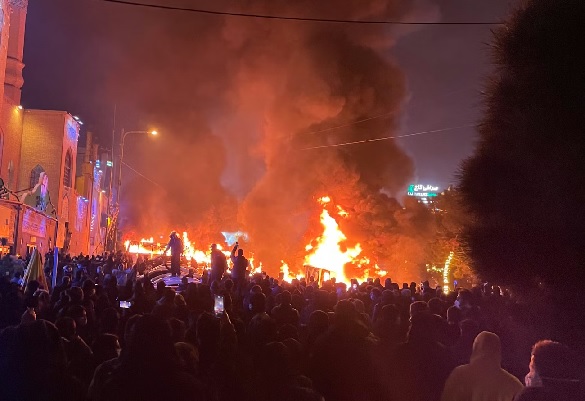
His admission raises the question of whether the sanctions regime is truly intended to change Iranian state behavior or if it is simply designed to manufacture an economic crisis that can be politically exploited by Israel and the American government, who attempted to stage a color revolution in that country last month. To achieve that end, American and Israeli involvement went beyond merely crashing Iran’s economy. An official Mossad account posting in Farsi urged Iranians to take to the streets, declaring, “we are with you in the field.” Former CIA Director Mike Pompeo echoed that message publicly. Meanwhile, Israel’s Channel 14 correspondent Tamir Morag wrote that “foreign actors are arming the protesters in Iran with live weapons,” which he said was “the reason for the hundreds of regime personnel killed.”

We have been told, by the same outlets and publishers who denied the Gaza genocide, that the Iranian government’s crackdown on those protests has killed tens of thousands of people in a mere two weeks, with Time magazine estimating the death toll at 30,000 people, with “the only parallel offered by online databases occur[ing] in the Holocaust.” Though, as Time was forced to admit, it has “been unable to independently verify” those numbers, and therefore there is little reason to believe them at all.

What is undeniable, however, is the effect that economic sanctions have had on Iran for decades, blocking that country’s access to the global banking system and depriving its population of life-essential medicines and goods. If sanctions neither dismantle Iran’s nuclear program nor curb its behavior in the region, yet reliably immiserate the population and generate unrest that foreign governments seek to weaponize, then the question is no longer whether sanctions “work,” but why Washington continues to pursue them—and how that policy serves it’s own interests rather than just Israel’s.

MINNEAPOLIS KILLINGS WERE CAUSED BY MILITARIZATION OF POLICE FORCES

The Cause Of The Tragedies Is: The Militarization Of All Police Forces In America, From The DHS/ICE At The Federal Level, To State Police, To Your Local County Sheriffs And City Police.

First consider the ICE officer who killed Renee Good in her car, Jonathan Ross. AP reported:

In courtroom testimony last month, Ross said he deployed to Iraq from 2004 to 2005 with the Indiana National Guard. Ross said he served as a machine gunner on a gun truck as part of a combat patrol team.

That means he was trained to see all civilians as potentially hostile, and having no rights. He would shoot at the first hint of hostility, and knock down doors of homes for any reason, or no reason. Once that’s ingrained in your nervous system, you can’t get rid of it. And that’s the nervous system that pervades law enforcement at all levels, passed on even to those who never were in the military.

He said he returned from Iraq in 2005, went to college and joined the Border Patrol in 2007 near El Paso, Texas. He worked there until 2015, serving as a field intelligence agent gathering and analyzing information on cartels and drug and human smuggling.

So Ross also joined the “war on drugs,” which as much as “regime change wars” abroad has militarized our police forces. A topic for another day.

Contrast Ross’ experience with World War II veterans, who killed uniformed German soldiers inside a Tiger tank, or in infantry units 50-300 yards away. Those G.I.s came home with a different nervous system toward their fellow Americans, including if they became policemen.

Outside the war experience, police departments have been heavily militarized, with an emphasis on SWAT teams involved in even routine arrests. When Trump confidante Roger Stone was arrested, a huge, heavily armed FBI team showed up and handcuffed him, despite his age and failing health and Trump even being president.

The federal government also has advanced militarization by giving local police military equipment. A 2025 study in the Harvard Law School National Security Journal was titled, “The Image of Combat, Not Community: A Critique on Law Enforcement Use of Military Equipment.” It found:

The concerns of militarization and the lack of widespread police regulations have spurred many military veterans to call for significant change. One former Marine states, “if cops are going to steal our gadgetry, they might consider adopting our overarching strategy too.” Much of the criticism notes that, while military forces have shifted tactics to “win the hearts and minds of the people,” law enforcement seems to be increasingly antagonizing its citizenry often along racial lines

Back to Minneapolis. This also is another case of what the CIA calls “blowback.” That is, a foreign war or caper “blows back” bad consequence to the American homeland.

Last year Trump bombed that unfortunate land of Somalia 100 times. And we’ve been at war there, one way or another, since President George H.W. Bush sent our troops in late 1992, supposedly to deliver humanitarian aid. Having wrecked their country, it’s not surprising hundreds of thousands have come to our country, and form the major part of Minneapolis’ immigration/ICE crisis.

Now we might get involved deeply in similar wars in Venezuela and even Iran. Although so far Trump has favored “quick in and out” operations. After all, he campaigned against the Iraq and Afghanistan quagmires. And let’s not forget most top Democrats – Pelosi, Schumer, Harry Reid, the Clintons – backed all these wars, and even started some of them. Obama opposed the wars in the Senate, then continued them as president, and bombed Libya into a civil war that continues.

They shouldn’t act so innocent about the mayhem back home when they also caused the blowback. When will they ever learn?

ISRAEL’S EXPANDING INFLUENCE IN LATIN AMERICA IS FUELED BY AMERICAN PRESSURE


Once A Bastion Of Anti-Imperialist Solidarity, Latin America Is Recalibrating Its Support For Palestine Amid American Political Pressure And Far-Right Shifts.

American political pressure in Latin America has helped open the door for growing Israeli influence, but longstanding solidarity with the Palestinian cause has not withered away, regional experts have said.

Several left-wing Latin American governments, which for decades had framed their foreign policy around anti-imperialism and decolonial identity, continue to express solidarity with the Palestinian cause – sometimes elevating symbolic gestures to state-level policy decisions.

During the height of Israel’s war on Gaza, Brazil’s president labelled the devastating offensive a genocide, Colombia suspended diplomatic relations with Israel and Chile sought accountability for Israeli actions in international courts.

But American interventions, including extensive lobbying by American politicians, threats against regional leaders and the recent seizure of Venezuelan President Nicolas Maduro, are geared towards tilting the region towards much closer alignment with Israel.

“Latin American states lack instruments of hard power and are therefore constrained in how they can respond to US pressure,” Ali Farhat, a Latin American affairs specialist, said.

“That limitation creates openings for Israel to consolidate influence, particularly where governments seek to avoid confrontation with Washington.”

In recent years, American officials have explicitly tied Latin American diplomacy to broader American foreign policy goals, framing their cooperation with Washington as a litmus test for “security” and “democratic alignment” that dovetails with closer ties to Israel.

Argentina’s far-right president, Javier Milei, whose government has announced plans to relocate Buenos Aires’ embassy to Jerusalem and deepen security and economic cooperation with Israel, has benefited directly from America.

Last year, Buenos Aires received an unprecedented $20bn bailout from Washington, which President Donald Trump defended as backing a “good financial philosophy” despite scepticism about its benefits to the country.

Farhat said that American intervention had played a decisive role in shaping the regional landscape, with Washington’s targeting of Venezuela’s leadership as emblematic of a broader pressure campaign aimed at weakening outspoken supporters of Palestine.

Maduro, long considered one of the most vocal defenders of Palestinian rights in Latin America, had been subjected to sustained international legal and political pressure, which Farhat said had already triggered repercussions.

“He [Maduro] was among the most uncompromising defenders of Palestine on the continent,” Farhat said. “His marginalisation [and now ouster] represents the loss of a fierce advocate for the cause.”

According to Farhat, Maduro – who was seized by American forces earlier this year and is currently standing trial in New York on drugs, weapons and “narco-terrorism” charges – held views that framed the Palestinian struggle as inseparable from anti-imperialism.

“He [Maduro] did not instrumentalise Palestine as a political tool,” Farhat said. “He was genuinely convinced that the US functions as a colonial power and that Israel operates as an occupying state supported by it.”

RECALIBRATING, NOT RETREATING

According to Farhat, since Trump returned to the Oval Office last year, his brash foreign policy strategy has resulted in left-leaning leaders responding by recalibrating, not retreating, when it comes to the issue of Palestine.

Colombia’s Gustavo Petro and Brazil’s Luiz Inacio Lula da Silva, known mononymously as Lula, have attempted to balance their condemnation of Israel’s actions in Gaza with pragmatic diplomacy, aware of the economic and political costs of escalation, he said.

“This caution should not be read as surrender,” Farhat said. “It is an attempt to contain what is perceived as American overreach in a region without credible deterrence tools.”

Brazil, he added, illustrated both the possibilities and limits of diplomacy.

While Lula’s stance on Gaza was among the strongest taken globally, it was ultimately constrained by broader geopolitical realities.

“Brazil could have gone further had there been effective Arab and Islamic political backing,” Farhat said. “The rush toward normalisation elsewhere weakened Brazil’s ability to escalate.”

At the same time, the resurgence of far-right governments has accelerated alignment with both the American regime and Israel.

Argentina’s Milei has marked one of the clearest pivots, framing Israel’s war on Gaza as legitimate self-defence and deepening ties with Israeli officials.

As of January 25th, Argentina is the only Latin American country to have agreed to join Trump’s controversial Board of Peace initiative.

The board describes itself as “an international organisation that seeks to promote stability, restore dependable and lawful governance, and secure enduring peace in areas affected or threatened by conflict”.

Nilto Tatto, a congressman with the Brazilian Workers’ Party, said it was critical that Latin American countries continued to reject offers to join the board and any of its initiatives that undermined Palestinian rights.

“Any framework managed by Washington would not serve peace so much as reproduce hegemony under an international guise,” Tatto said.

“Brazil, evidently, cannot take part in a process whose outcome is already predetermined, namely, one that focuses on the reconstruction of the Gaza Strip only to then keep the territory under US control.”

Julia Perie, a former member of the Argentine parliament, said Argentina’s position towards Israel reflected a broader ideological realignment rather than a targeted attack on Palestinians.

“Argentina’s position is part of a geopolitical vision that prioritises alignment with the United States,” said Perie, who is also president of the Victoria Foundation’s International Relations Observatory.

“It’s not so much a direct punishment of the Palestinian cause as it is a convergence of agendas within a western-aligned axis,”

While far-right governance has limited state-level advocacy for Palestine, Perie said that such moments are cyclical rather than definitive.

“Support for Palestine in Latin America has always fluctuated,” she said. “This is another phase in a longer historical transformation, not the end of solidarity.”

GLOBAL SOUTH STRUGGLE

In countries facing heightened political pressure, observers said support for Palestine was increasingly expressed through legal channels, multilateral institutions and popular movements rather than overt diplomatic confrontation.

Ramon Medero, president of Venezuela’s La Danta TV, described the current phase as one of adaptation rather than retreat.

“It is difficult to argue that the Palestinian cause has suffered a decisive blow,” Medero said.

“What we are seeing is a repackaging of escalation through legal and multilateral avenues to reduce the costs of sanctions and backlash.”

For Medero, solidarity with Palestine was now firmly embedded within a broader Global South struggle against colonial domination.

“The Palestinian cause has become a structural symbol of liberation, sovereignty and self-determination,” he said. “What is shifting is agency – away from governments and toward popular consciousness.”

He added that far-right advances may intensify grassroots mobilisation.

“The scale of the atrocities in Gaza and the documentation of genocide have awakened popular conscience worldwide,” Medero said.

“Where the far right prevails, these struggles gain even greater meaning.

“The enemies of Palestine and of our America [Latin America] are the same – and the struggles are converging.”

Design a site like this with WordPress.com
Get started