Half the Syrian soldiers I’ve interviewed have later been killed.
I’ve spent months these past eight years in Syria’s amputated cities. They are a scar on all our lives – the Russians, the Syrians, the armed Islamists, the western powers that spent more time trying to destroy Syria than the Syrian regime.
The bodies buried deep within these heaps of concrete, the survivors, and those invisibly but forever mentally wounded have paid the price of our military cruelty and indifference. Many of those who fled these gaunt cities are now in Europe – or at the bottom of the Mediterranean. And we don’t even know – or care? – about the statistics. Did 350,000 die here? Or 450,000? Or 500,000? These figures have all been used, a careless 150,000 separating the first from the last.
Beirut, Mostar, Sarajevo, Aleppo, Homs, and now Mosul and Raqqa – we are forced to ask ourselves if these sepulchral ruins are something we have come to regard as natural, something we accept or have accepted for hundreds of years: that destruction is a natural part of history.
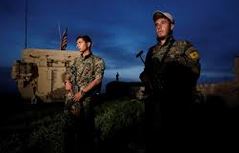
I hope I don’t believe this. I’ve driven thousands of miles across Syria, with no minders (they are mostly called up into the army) and no protection to reach front lines where Syrian government soldiers, often wounded, have run and crawled through the broken concrete to show me Isis flags in the next field or broken house.
If they cross the lines, journalists will have their heads cut off – which is why there are no Western reporters based in the government-besieged province of Idlib (they only very rarely ever visit). And I’ve always believed that regimes are to be avoided. I’m one of the few journalists I know who has not interviewed Assad. Talking to armies can reveal the truth.
I reckon half the Syrian soldiers I’ve interviewed have later been killed. The total dead of the entire army is a state secret, but I’ve discovered the real figure: around 85,000 – quite a toll for the Assad regime’s only real defenders. Until the Russians came. I talk to them all. It’s my job. One general, ‘The Tiger’, was so used to gunfire that he spoke while sitting in a field erupting with shell explosions – until I realized he was already, in his own mind, ready to be killed, and I explained that I could hear him more clearly if we were in a trench.
That’s what you’ve got to remember in all wars: that you are going there to report – not to die.
View the current impeachment proceedings against Donald Trump through the lens of ‘deep politics’.
“The President of the United States is a transient official in the regard of the warfare conglomerate. His assignment is to act as master of ceremonies in the awarding of posthumous medals, to serve when needed as a salesman for the military hardware manufacturers and to speak as often as possible about the nation’s desire for peace. He is not free to trespass on the preserve of the war interests nor even to acknowledge that such an organism exists.” – Jim Garrison (May 27, 1969)
The murder of President John F. Kennedy on November 22, 1963 is widely recognized as a pivotal moment in U.S. history.
It was the first assassination of a U.S. president in the television age. The death of Kennedy enabled Cold Warriors within Washington to pursue their pillaging of the African, South American and Asian continents with substantially less resistance. But perhaps just as significantly, it marked an important chapter in a long-standing power struggle between big moneyed interests in America along with their intelligence operatives, and recognizable constitutional government, made up of representatives elected by the people and accountable to the public.
It was in direct response to inconvenient questions around the first Kennedy assassination that the CIA weaponized the term ‘conspiracy theory,’ a thought-stopping ad-hominem attack intended to disarm truth-seekers challenging the crimes that a controlled media fail to thoroughly investigate.
The existence of Wall Street overlords acting in tandem with military-intelligence figures as a kind of shadow government or ‘Deep State’ to appropriate the foreign policy and warmaking apparatus of a country puts in doubt any assertions of America as a properly functioning democracy with power overseen and exercised by duly appointed representatives.
There have been several examples of similar State Crimes Against Democracy deliberately concealed and covered up so as to protect unaccountable elites. The assassinations of John Kennedy’s brother Robert, Martin Luther King, and Malcolm X, as well as the (false flag) terrorist attack known as 9/11 being among the more famous examples.
Against this backdrop, we witness the spectacle of President Trump having his authority challenged in an exhaustively publicized impeachment proceeding. Considering documented war crimes and other malfeasance committed by presidents spanning the last half century, one wonders why the particular allegations against Trump are being pursued so relentlessly, and not others. At the end of the day, impeachment or no, will the people end up with a marginally more accountable government, or will the unaccountable power behind the throne have been reinforced by this 21st Century Kabuki theater?
This week’s episode of the Global Research News Hour radio program is as much an attempt to view the current impeachment proceedings against Donald Trump through the lens of ‘deep politics’ as an anniversary commemoration of the assassination of one of America’s most popular presidents. We have taken the liberty to reach out to two authoritative scholars of events like the Kennedy assassinations and 9/11 to get their insights into what the Trump impeachment drama might mean from the stand-point of entrenched unaccountable power within the USA.
Indispensable No More? – How the American Public Sees U.S. Foreign Policy.
American exceptionalism is the belief that the foreign policy of the United States should be unconstrained by the parochial interests or international rules which govern other countries. Writing in The Atlantic earlier this year, Jake Sullivan defines American exceptionalism as the understanding that, “despite its flaws, America possesses distinctive attributes that can be put to work to advance both the national interest and the larger common interest.” Not only is the United States uniquely equipped to divine a larger common interest, but it has the singular opportunity to pursue and protect it.
Last year we discovered most Americans think the United States is exceptional because of the example it sets than for the active role it takes in world affairs. Americans were more than twice as likely to believe “America is exceptional because of what it represents” than believe “America is exceptional because of what it has done for the world.” Although this remains true this year, the number of people who believe America is an exceptional country because of what it represents declined by 7 percent since last year. Those who believe America is not an exceptional country increased by roughly that amount.
The rise in anti-exceptionalism was most pronounced among younger Americans. It was the top answer choice for respondents under 45 years old. Fully 55 percent of those between 18 and 29 believe the United States is not an exceptional country, as do a plurality of Democrats, Independents, and unaffiliated voters.
This sharp increase in the number of people disavowing American exceptionalism and decrease in people thinking America is exceptional for what it represents takes place amid a backdrop of escalating attacks on democratic institutions by the Trump administration, and an impeachment inquiry which highlights deep partisan divisions within Congress.
Threat Perception Is Split Along Partisan Lines
Americans continue to be split along party lines when asked about the greatest threat facing the U.S. in the 21st century. A plurality of Democrats and Independents are concerned with “a rise in populist and authoritarian governments.” Republicans, on the other hand, fear America is “losing its national identity due to high levels of immigration.” Democrats, Republicans, and Independents all ranked as the second most urgent threat: “Americans becoming distrustful of democratic institutions and less committed to participating in civic life.”
The potential threat posed by immigration and a loss of national identity was ranked last among Democrats and ranked first among Republicans. These results continue to reflect a stark contrast in how people with different partisan identities view different threats.
Such policies reflect a deep rooted thread of racism at the heart of American politics.
With next year’s presidential election drawing ever closer, and impeachment proceedings going forward against current leader Donald Trump, American citizens are facing existential questions about the nature of their democracy. The United States was founded on the promise of revolution – a war was fought and won on the rejection of the Old World’s hierarchical societies, and the glass ceilings that inhibited the freedom and progression of the non-ruling classes. America’s demonstrative patriotism is, in fact, often startling to outsiders. The pledge of allegiance, national anthem, and ubiquity of the flag build up a sense of American exceptionalism at the heart of public culture, fundamentally woven into daily life, and rooted in the belief that the nation offers a unique promise unmatched in other countries. Yet, the very ideals of democratic inclusion on which the United States celebrates itself is increasingly at risk. Despite the promise that all men are created equal – affirmed in the Declaration of Independence as the nation wrote itself into being – political maneuverings over the past few years reflect the sustained challenges of transforming that equality from an aspiration into a reality.
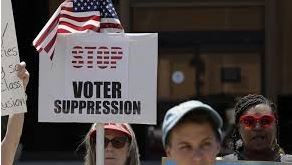
Reports and studies have suggested that there are significant voter suppression tactics occurring as we speak, with a noteworthy spike in efforts rising since Trump’s election in 2016. Such strategies are largely designed to shape electoral maps in favor of incumbent public officials and candidates running for the Republican Party. Some might argue that this is simply how politics works: those in power will do what they can to maintain it, and strategies such as gerrymandering are coeval with democracy itself. A closer examination of these techniques, and the populations they target, however, reveals the underlying biases that remain a fundamental impediment to genuine equality. Despite the promise of one person, one vote, recent efforts by the Republican Party have disproportionately sought to strip the right to vote from African Americans and people of colour (who typically vote for the Democrats) across the nation.
Such policies reflect a deep-rooted thread of racism at the heart of American politics – a wound that has festered since the nation shaped itself through slavery and, in academic George Lipsitz’s words, the possessive investment in whiteness as cultural capital. The systemic racism of disenfranchisement can be traced through America’s history: under slavery, the Constitution included a clause that valued black lives at the rate of ⅗ of whites’, adjusting population counts to increase the wealth and voting power of slaveholders. After the Civil War, Jim Crow legislation suppressed the supposedly liberated black vote by making voting near-impossible through segregation, violence, and prohibitive requirements. One of the outrages of the 2016 elections was the clarity with which such strategies have been resurrected. Georgia’s Democratic candidate Stacey Abrams amassed unprecedented success as an underdog, calling attention to the 1.5 million voters disenfranchised by her Republican competitor Brian Kemp. Despite a narrow loss, she has expanded her voter registration campaign nation-wide to encourage people of colour to participate in elections. In Florida, Democratic Gubernatorial candidate Andrew Gillum lead a successful campaign to restore voting rights to ex-felons – an outcome that enables over 1 million formerly disenfranchised people to vote, against a staggering near 18 per cent of the state’s black population who had been politically excluded. Indeed, while scholar Michelle Alexander defines the ‘new Jim Crow’ in response to the overwhelming incarceration of African Americans, there are clear links between this imprisonment and the desire among some policymakers to exclude the black population from public society.
Just 10 Democrats defied the leadership to vote against the resolution to extend the administration’s authority to warrantlessly gather data on Americans.
House leadership included the measure in a government funding bill—and even members of the Congressional Progressive Caucus went along with it.
It may seem to many Americans that Washington is entirely consumed by the impeachment inquiry, and that no other important business is getting done on Capitol Hill. But on Tuesday, in a break from televised hearings, the House of Representatives voted to fund the government through December 20. If passed by the Senate, the continuing resolution would prevent a government shutdown and forestall a debate about border-wall funding.
That’s all well and good, except that Democratic leaders had slipped something else into the bill: a three-month extension of the Patriot Act, the post-9/11 law that gave the federal government sweeping surveillance and search powers and circumvented traditional law enforcement rules. Key provisions of the Patriot Act were set to expire on December 15, including Section 215, the legal underpinning of the call detail records program exposed in the very first Edward Snowden leak.
“It’s surreal,” Representative Justin Amash told me on Tuesday, just before the vote. Amash, an independent who left the Republican Party over his opposition to President Trump, pointed to the hypocrisy on both sides of the aisle. Republicans have “decried FISA abuse” against the president and his aides, he said, referring to the Foreign Intelligence Surveillance Act, “and Democrats have highlighted Trump’s abuse of his executive powers, yet they’re teaming up to extend the administration’s authority to warrantlessly gather data on Americans.”
By tucking the measure into a must-pass bill, House Speaker Nancy Pelosi forced many members who oppose the Patriot Act to vote in favor of its extension. “Although I do have serious concerns with reauthorizing Section 215,” Representative Bobby Rush of Illinois told The Hill, “we must focus on the bigger picture here.” In late October, Rush signed a letter co-authored by Representatives Rashida Tlaib and Earl Blumenauer, which read, “We will not support any legislation that extends Section 215’s sunset date if it fails to contain robust reforms that protect innocent people from unjust surveillance.
On Monday night, Amash submitted an amendment to strip the Patriot Act language from the budget bill, but the amendment was blocked by Democrats on the Rules Committee. Just 10 Democrats defied the leadership to vote against the resolution, including Tlaib, Alexandria Ocasio-Cortez, Ayanna Pressley, and Ilhan Omar (a.k.a. “the Squad”). “I cannot in good conscience vote in favor of a [continuing resolution] that reauthorizes unconstitutional mass surveillance authorities,” Tlaib told me, “especially under a president who has retweeted images of his opponents jailed and suggests anyone who disagrees with him is a criminal.” AOC tweeted before the vote, “Yeah that’s gonna be a no from me dog.”
Ultimately, the funding bill passed 231-192, mostly on party lines.
Some advocates have questioned whether the Congressional Progressive Caucus (CPC), which includes the Squad, should have done more to combat—or, at least, register its dissatisfaction with—the last-minute maneuver by Democratic leadership. On Wednesday morning, leaders of the CPC and the libertarian House Freedom Caucus circulated a joint letter on Capitol Hill calling for extensive reforms to the Patriot Act before it is reauthorized. But when it came time for the floor vote, CPC co-chairs Pramila Jayapal and Mark Pocan voted in favor of the funding measure. So did most of the caucus’s members. The only person in CPC leadership to vote against the bill was Omar.
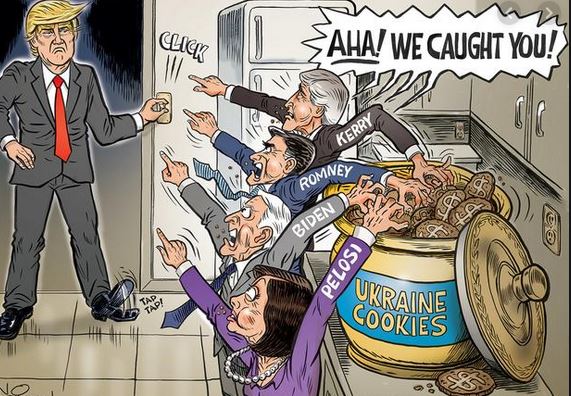
People make policies which extend the Empire – as did these Clintonistas with the NATO expansion project – and then cash-in afterwards by peddling influence.
We heard some knucklehead on the War Channel (CNN) braying about Ukraine as a vitally important “ally and strategic partner”. The implication, of course, was that the Donald’s attempted squeeze play on its new President was dangerously undermining national security.
That is pure bull!
The safety and security of the American homeland has absolutely nothing to do with it. That’s because Ukraine is a no count, strategically irrelevant patch of earth that was long ago ruined by the old Soviet Union, and thereafter turned into an economic trainwreck by its own corrupt oligarchs – along with plenty of help from Washington interventionists.
The latter spent the post-Soviet years fomenting “color revolutions” and attempting to steer its politics toward the west and NATO membership. But when the Ukrainian people elected a pro-Russian president in 2010 and all efforts to bribe and bully him westward failed, Washington instigated, funded and instantaneously recognized an illegal putsch on the streets of Kiev in February 2014.
That blatant, unprovoked assault on a sovereign nation, in turn, set in motion a destructive civil war internally; a dangerous and utterly unnecessary politico-military confrontation with Russia on its own doorstep; and, now, a hysterical campaign by the House Dems and their Deep State allies to impeach a duly-elected American president for the sin of wading into the very cesspool of corruption that the Washington establishment itself foisted upon this hapless, $150 billion sliver of a failed state and crippled economy.
The latest dispatch from the Wall Street Journal on the stench wafting westward from Kiev reveals more about the rotten foundation of UkraineGate than its authors probably understood.
Burisma Holdings’ campaign to clean up its image in the West reached beyond the 2014 hiring of Hunter Biden, son of the then-U.S. vice president, to include other well-connected operatives in Washington, according to officials in both countries and government records.
The Ukrainian company, owned by tycoon Mykola Zlochevsky, also hired a lobbyist with close ties to then-Secretary of State John Kerry, as well as a consulting group founded by top officials in the Clinton administration that specialized in preparing former Soviet-bloc countries to join NATO (Blue Star Strategies).
Soon the efforts bore fruit. With the help of a New York-based lawyer, Mr. Zlochevsky’s U.S. consultants argued to Ukrainian prosecutors that criminal cases against the company should be closed because no laws had been broken.
Burisma later became a sponsor of a Washington think tank, the Atlantic Council, whose experts are often cited on energy and security policy in the former Soviet Union.
Simple translation: Zlochevsky was an ally, officeholder (minister of ecology and natural resources) and inner-circle thief in the ousted government of Viktor Yanukovych. He therefore needed to powder the pig fast and thoroughly in order to hold onto his ill-gotten billions.
So he hired the best Washington influence peddlers that money could buy under the circumstances. First up was Hunter Biden, because his old man was running point on what amounted to the puppet government Washington had installed in Kiev, and Devon Archer, because he was a former bundler for former Senator (and then Secretary of State) John Kerry.
But so as to leave no stone unturned, Zlochevsky also had Burisma hire another Washington influence peddler just one month after Biden the Younger joined the board in April 2014. Again, according to the WSJ, the additional lobbyist firepower came from one,
David Leiter of Washington lobbying firm M.L. Strategies….. Mr. Leiter was John Kerry’s chief of staff when Mr. Kerry was a U.S. senator from Massachusetts….According to disclosure records, Mr. Leiter, who also had worked for the Energy Department, lobbied on behalf of Burisma on “promoting transparency and good corporate governances” at both chambers of Congress, the State Department, the Treasury Department, the Energy Department, and US AID.
Needless to say, only in Imperial Washington would all the above named arms of the US government care a whit about “transparency and good governance” at a two-bit gas producer in Ukraine. During 2018, for example, the company produced the trivial sum of 1.3 BCF of natural gas and booked revenues of just $400 million – a rounding error in just about any energy market that matters.
But as it happened, Washington was calling the shots in Kiev, and Burisma needed its government licenses and gas concessions. So the lobbying happened on the banks of the Potomac where the real power was actually exercised.
Finally, the Clinton wing of the Washington racketeering system had to be covered, too – hence the above mentioned Blue Star Strategies. And the bolded sentence from the WSJ story quoted below tells you all you need to know about its business, which was to “….help former Soviet countries prepare for NATO consideration”.
That’s right. With the Soviet Union gone, its 50,000 tanks on the central front melted-down for scrap and the Warsaw Pact disbanded, the rational order of the day was to declare “mission accomplished” for NATO and effect its own disbandment.
The great parachuter and then US president, George Bush the Elder, could have actually made a jump right into the giant Ramstein Air Base in Germany to effect its closure. At that point there was no justification for NATO’s continued existence whatsoever.
But the Clinton Administration, under the baleful influence of Washington busybodies like Strobe Talbot and Madeleine Albright, went in just the opposite direction. In pursuit of Washington’s post-1991 quest for global hegemony as the world’s only superpower and putative keeper of the peace, they prepared the way for the entirety of the old Warsaw Pact to join NATO.
I told my colleagues, they’re going to try to kill me,” – “Because they’re going to kill the messenger.
“Are you afraid, Mr. Mayor, that you could be indicted?” Henry asked.
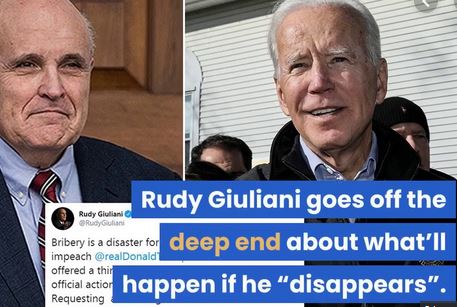
“Oh, wow, how long have you known me, Ed?” Giuliani said, “Do you think I’m afraid? Do you think I get afraid? I did the right thing. I represented my client in a very, very effective way. I was so effective that I’ve discovered a pattern of corruption that the Washington press has been covering up for three or four years.”
“You should have jumped all over this in 2015 when this awful conflict was mentioned and it was hidden and suppressed by the Washington press,” he continued. “The reality is, I’m embarrassing you because you didn’t do your job, and I’m also going to bring out a pay-for-play scheme in the Obama administration that will be devastating to the Democrat Party.”
“I expected, the moment I heard Biden’s name, I told my colleagues, they’re going to try to kill me,” he said. “Because they’re going to kill the messenger. But damn it, the mafia couldn’t kill me, your colleagues are not going to kill me.”
The material submitted to the committee includes audio, video and photos that include Giuliani and Trump.
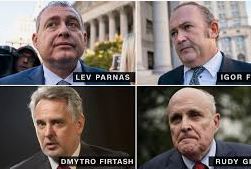
The House Intelligence Committee is in possession of audio and video recordings and photographs provided to the committee by Lev Parnas, an associate of President Donald Trump’s personal attorney, Rudy Giuliani, who reportedly played a key role in assisting him in his efforts to investigate former Vice President Joe Biden and Ukraine, multiple sources familiar with the matter tell ABC News.
The material submitted to the committee includes audio, video and photos that include Giuliani and Trump. It was unclear what the content depicts and the committees only began accessing the material last week.
“We have subpoenaed Mr. Parnas and Mr. [Igor] Fruman for their records. We would like them to fully comply with those subpoenas,” House Intelligence Committee Chairman Adam Schiff told CNN Sunday, with a committee spokesperson adding they would not elaborate beyond the chairman’s comments.
An attorney for Parnas, Joseph A. Bondy, also declined to comment, directing ABC News to a statement released earlier in the day Sunday reading in part, “Mr. Parnas has vociferously and publicly asserted his wish to comply with his previously issued subpoena and to provide the House Intelligence Committee with truthful and important information that is in furtherance of justice, not to obstruct it.” The statement goes on to say, “His evidence and potential testimony is non-partisan, and not intended to be part of a battle between the left and the right, but rather an aid in the determination by our government of what is in the best interests of our nation.”
Sources tell ABC News the tapes were provided as part of that congressional subpoena issued to Parnas, and the former Giuliani ally also provided a number of documents both in English and Ukrainian to the committee in two separate productions, sources told ABC News. However, some of the material sought by congressional investigators is already in possession of federal investigators within the Southern District of New York and thus held up from being turned over, according to sources familiar with the matter. Parnas’ associate, Fruman, has not cooperated with the committee.
Parnas, a Ukraine-born, American businessman, was subpoenaed last month by House committees at the same time as Fruman. The two men had previously announced through their attorney at the time that they would not be complying with the subpoena. Separate from the House impeachment probe, Parnas and Fruman were arrested earlier this fall at the Dulles International Airport just outside of Washington, with one-way international tickets, and charged in a criminal campaign finance case in the Southern District of New York.
Accused of allegedly circumventing campaign finance laws against straw donations and foreign contributions, Parnas and Fruman pleaded not guilty. According to the indictment, Parnas sought then-Ukraine Ambassador Marie Yovanovitch’s ouster earlier this year along with his efforts to get Ukrainian officials to investigate the president’s political rival, matters that have repeatedly emerged in the House impeachment inquiry. Giuliani’s relationship with Parnas and Fruman is the subject of a criminal investigation in the Southern District of New York, that case will have its next court date early next month.
China’s New Silk Road is creating a multi-polar world, where all participants will benefit.
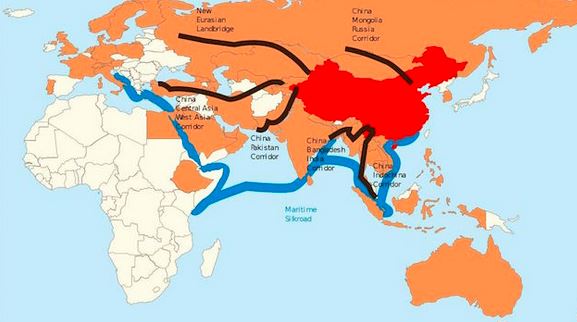
The Belt and Road Initiative (BRI), also called the New Silk Road, is based on a 2,100-year-old trade route between the Middle East and Eastern Asia, called the Silk Road. It wound its ways across the huge landmass Eurasia to the most eastern parts of China. It favored trading, based on the Taoist philosophy of harmony and peaceful coexistence – trading in the original sense of the term, an exchange with “win-win” outcomes, both partners benefit ting equally.
Today, in the western world we have lost this concept. The terms of trade are imposed always by the ‘stronger’ partner, the west versus the poorer south – the south where most of the natural resources are lodged. Mother Earth’s assets have been and are coveted by the west – or north – for building and maintaining a lifestyle in luxury, abundance and waste. This trend has lasted for centuries of western colonialism: Exploitation, loot, evisceration and rape of entire peoples of the Global South by the Global North, to use the current soothing World Bank lingo.
The New Silk Road, or BRI, is Chinese President Xi Jinping’s brainchild. It’s based on the same ancient principles, adjusted to the 21st Century, building bridges between peoples, exchanging goods, research, education, knowledge, cultural wisdom, peacefully, harmoniously and ‘win-win’ style. On 7 September 2013, Xi presented BRI at Kazakhstan’s Nazarbayev University. He spoke about “People-to-People Friendship and Creating a better Future”. He referred to the Ancient Silk Road of more than 2,100 years ago, that flourished during China’s Western Han Dynasty (206 BC to 24 AD).
President Xi’s vision may be shaping the world of the 21st Century. The Belt and Road Initiative is designed and modeled loosely according to the Ancient Silk Road. President Xi launched this ground-breaking project soon after assuming the Presidency in 2013. The endeavor’s idea is to connect the world with transport routes, infrastructure, industrial joint ventures, teaching and research institutions, cultural exchange and much more. Since 2017, enshrined in China’s Constitution, BRI has become the flagship for China’s foreign policy.
BRI is literally building bridges and connecting people of different continents and nations. The purpose of the New Silk Road is “to construct a unified large market and make full use of both international and domestic markets, through cultural exchange and integration, to enhance mutual understanding and trust of member nations, ending up in an innovative pattern with capital inflows, talent pool, and technology database”. BRI is a perfect vehicle for building peacefully a World Community with a Shared Future for Mankind – which was the theme of an international Forum held in Shanghai, from 5-7 November, a tribute to China’s 70th Anniversary of her Revolution and achievements – with a vision into the future.
BRI is a global development strategy adopted by the Chinese Government. Already today BRI has investments involving more than 150 countries and international organizations – and growing – in Asia, Africa, Europe, the Middle East and the Americas. BRI is a multitrillion investment scheme, for transport routes on land and sea, as well as construction of industrial and energy infrastructure and energy exploration – as well as trade among connected countries. Unlike WTO (World Trade Organization), BRI is encouraging nations to benefit from their comparative advantages, creating win-win situations. In essence, BRI is to develop mutual understanding and trust among member nations, allowing for free capital flows, a pool of experts and access to a BRI-based technology data base.
“If giving some people liberty while denying it to others because of their race, ethnicity or religion was wrong in the segregated South, why isn’t it wrong in the West Bank?”
The Trump administration said Israeli settlements in the West Bank don’t violate international law. That’s absurd. Among international lawyers, the consensus that settlements are illegal rivals the consensus among international scientists that humans contribute to climate change. As UCLA’s Dov Waxman has pointed out, the legal advisor to Israel’s own foreign ministry admitted that “civilian settlement in the administered territories contravenes explicit provisions of the Fourth Geneva Convention” after Israel conquered the West Bank in 1967.
But critics who condemn the Trump administration for disregarding international law are missing the deeper point. So are critics who condemn it for undermining the two-state solution.
Fundamentally, the problem with settlements is neither legal nor geopolitical. It is moral. Israeli settlements in the West Bank are institutionalized expressions of bigotry. The American and Israeli politicians who legitimize them are the moral equivalent of those politicians who legitimized Jim Crow. It’s time they be treated as such.
Settlements only exist because Jews and Palestinians in the West Bank live under a different law. Jews are Israeli citizens: They can vote for the government that controls every square inch of the West Bank. Palestinians are Israeli subjects: Permanently barred because of their ethnicity and religion from citizenship in the country in which they live. (Yes, Palestinians have at times voted for the Palestinian Authority. But the PA is not a government; it is Israel’s subcontractor. PA officials — like all West Bank Palestinians — need Israeli permission to travel from one part of the West Bank to another).
Because the Israeli government controls the West Bank, and because it is accountable to the Jews — but not the Palestinians — who live there, it has spent the last half-century seizing land on which Palestinians live and giving it to Jews. Employing an 1858 Ottoman law, it has declared much of the West Bank “state land” and then transferred that supposedly ownerless territory to Jewish settlements. According to data from Israel’s own civil administration, almost 40% of the land on which settlements reside was once owned by individual Palestinians.
Big deal, some settlement defenders argue: Lots of people live on stolen land. If a community built on land seized by force is morally illegitimate, then the New Yorkers who live on territory once owned by Native Americans have no more right to be there than the Jewish settlers in Beit El.
But there’s a difference: New York is now open to people of any religion or race. Native Amerians, as citizens of the United States, can live there. Palestinians can’t live in Beit El. Jewish settlements are Jewish-only settlements. The West Bank isn’t like New York in 2019. It’s like Mississippi in 1959. It is a territory segregated by law, separate and hideously unequal.
That’s what Benjamin Netanyahu obscures when he tweets that the Trump administration’s new settlements policy “reflects an historical truth – that the Jewish people are not foreign colonialists in Judea and Samaria.”
Of course, Jews are not foreign to the West Bank. Much of the Book of Genesis takes place there; there were Jewish communities in the West Bank before Israel’s creation. But morally, the issue is not whether Jews have the right to live in the West Bank. It’s whether Jews have the right to live there under a different law than their Palestinian neighbors.


 Hidden History -- In The Making