TRUMP NOW SAYS HE WILL NOT STRIKE IRAN WITH NUCLEAR WEAPONS

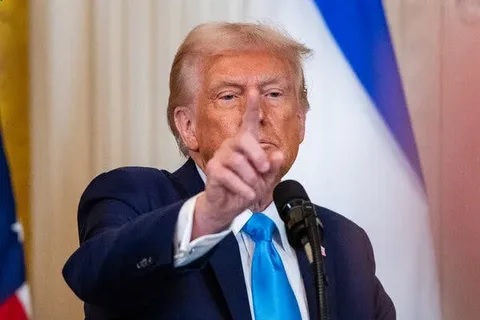
Trump On Thursday Ruled Out Striking Iran With A Nuclear Weapon, After His Previous Threats To Completely Destroy Iranian Civilization.

“No, I wouldn’t use it,” Trump told reporters at the White House.

“Why would I use a nuclear weapon when we’ve, in a very conventional way, decimated them without it?” he asked.

“A nuclear weapon should never be allowed to be used by anybody.”

Trump on April 7th issued a genocidal threat to Iran that a “whole civilization will die tonight, never to be brought back,” but within hours agreed to a ceasefire that he has since extended in the war launched by the United States and Israel.

Vice President JD Vance during the conflict warned that the United States was ready to intensify damage on Iran with weapons not previously used, but the White House denied he was threatening nuclear strikes.

Vance in failed negotiations had pushed Iran for greater concessions on its contested nuclear work.

Trump told reporters that he was seeking an Iran “without a nuclear weapon that’s going to try and blow up one of our cities or blow up the entire Middle East.”

Iran denies seeking a nuclear weapon and the UN nuclear watchdog says that an atomic bomb was not imminent before the war.

The United States is the only country to have used nuclear weapons in combat, obliterating the Japanese cities of Hiroshima and Nagasaki at the end of World War II, killing some 214,000 people.

Israel is widely known to have nuclear weapons but does not publicly acknowledge them.

Trump’s blanket statement against any nuclear use would appear to be at odds with longstanding American nuclear doctrine, which reserves the right to use nuclear weapons.

Trump has previously called for an end to an American moratorium on nuclear testing in response to American allegations of secret testing by China and Russia.

Former president Barack Obama had called for an eventual goal of a world without nuclear weapons, but his administration also said that so long as they existed, the American arsenal would serve as a deterrent.

The United States has rejected calls to declare that it will never use nuclear weapons first in a conflict.

A LEBANESE INFANT WAS SLAIN IN AN ISRAELI STRIKE ON HER FATHER’S FUNERAL

An Israeli Strike On A Funeral Killed Four People From The Same Family Over The Weekend, Including Infant Under Two Years Old Who Was There For Her Father’s Funeral.

Saeed’s father was killed on Wednesday, during an attack on her family home in the village of Srifa. The attack was one of hundreds of Israeli strikes carried out on Wednesday, the first day of the ceasefire, which killed hundreds of people across Lebanon.

The funeral wasn’t just for her father, but for multiple other family members who were also killed in the strikes. Her father was slain along with six others in that strike, and then Taleen and three other relatives were killed in the attack on the funeral.

Multiple members of the Saeed family were wounded in the attack on the Srifa home, and multiple more were wounded in the funeral strike. This brings the toll to 11 killed and numerous others wounded between the strikes, and with the Saeed family still needing to hold a funeral for the people killed in the last funeral, leaving open the question of whether that funeral will be targeted as well.

The real open question though is why the home in Srifa was targeted in the first place, let along the attack on the funeral for the people killed in Srifa. While Israel is increasingly lionizing their attacks as being about fighting Hezbollah, and tends to label anyone they happen to kill as a Hezbollah figure, they have yet to comment at all on the Srifa strike to try to justify it, nor have they attempted to label Taleen and her relatives, killed at the funeral, as anything to do with Hezbollah either.

As Israel has escalated the rate of attacks in the past week, since the ceasefire was announced, they’ve been killing a larger number of people per day, and subsequently are giving less time to explaining each individual killing. Taleen Saeed’s death will likely remain unjustified.

IN ISRAEL’S PRISONS SEXUAL VIOLENCE IS AN “ORGANIZED STATE POLICY”

Palestinian Testimonies Reveal How Sexual Violence, Including Rape Using Objects And Dogs, Is Approved By ‘Highest Levels’ Of Israeli Leadership.

Sexual torture of Palestinian detainees from Gaza in Israeli prisons is an “organised state policy”, endorsed by the “highest, political, military, and judicial authorities”, a new report has revealed.

The report is based on testimonies from Palestinian former prisoners gathered by the rights watchdog Euro-Mediterranean Human Rights Monitor.

It reveals how the scope of sexual violence of Palestinian prisoners, including rape using objects and trained military dogs, constitutes an “organized state policy”, aided and abetted by Israeli institutions and leadership.

One former detainee, a 42-year-old woman from north Gaza who was held in the notorious Sde Teiman detention centre, said she was bound naked to a metal table and repeatedly raped by two masked soldiers over the course of two days.

She recalled that she was left shackled, naked and bleeding throughout the night before the soldiers returned the next day to continue raping her.

She said she wished for death and likened her experience to “another genocide behind walls”.

Throughout her ordeal, she was filmed. Soldiers later showed her the footage while she was hung by her wrists under interrogation, threatening to publish the videos if she did not “cooperate”.

Amir, a 35-year-old Palestinian man also held at Sde Teiman, recounted how soldiers forced him to strip naked, before their dogs urinated on him and raped him.

He described how the dog “penetrated my anus in a trained manner while I was being beaten”.

“This continued for several minutes. I felt profoundly humiliated and violated.”

Khaled Mahajna, an attorney with the Commission of Detainees and Ex-Detainees Affairs, described how a soldier in Sde Teiman inserted a fire extinguisher nozzle into a Palestinian prisoner’s anus and then discharged its contents into his body, resulting in severe internal injuries and intense pain.

ETCHED INTO THEIR MEMORY”

Another former prisoner, 43-year-old Wajdi, recounted being shackled to a metal bed and repeatedly raped by soldiers and a trained dog.

“I felt severe pain in my anus and screamed, but every time I screamed, I was beaten. This continued for several minutes, while soldiers filmed and mocked me, Wajdi said.

“The soldier left after ejaculating inside me. I was left in a humiliating position. I wished for death. I was bleeding.”

He said he was then untied and raped by the dog. Later, another soldier forced his penis into the victim’s mouth and urinated on him. Over the following days, the abuse continued, with repeated rapes carried out by multiple soldiers.

“This case is particularly devastating because it reflects an accumulation of almost every form of torture, physical, psychological, and moral, layered with systematic humiliation,” Khaled Ahmed, a Euro-Med field researcher said.

“It also includes the deliberate use of multiple perpetrators and trained dogs as instruments of sexual violence. The result is not a single act of abuse, but an extended pattern of cruelty designed to destroy dignity, bodily integrity, and any sense of safety. These are acts that defy comprehension.”

Victims said the attacks were filmed and often conducted in “well-equipped institutional logistical settings… intentionally designed to enable torture and sexual violence”. The report said this evidenced the institutionalised nature of the violence.

Ahmed, who conducted some of the interviews with the victims, said the process was “by no means an easy task”.

“The soldier left after ejaculating inside me. I was left in a humiliating position. I wished for death. I was bleeding”

-Wajdi, former prisoner

“The details the survivors described and the way they relived the emotions and events were overwhelming,” Ahmed said.

He described how some interviewees broke down in crying fits while recounting their stories, noting that the participants’ fear of reprisals and social stigmas around sexual abuse stopped some of them from speaking altogether.

“But what we noticed was that all of them spoke about what happened as if they were seeing it in front of them,” Ahmed said.

“They remembered every detail, as though the scene had been etched into their memory and could never leave it.”

Ahmed said that most of the victims he spoke to were men, as women who experience sexual violence face a much deeper and more complex stigma in Palestinian society, “making it nearly impossible for a woman or her family to disclose that she has been assaulted”.

He noted that, while the sexual violence used against men and women is largely similar, women’s bodies in particular were used as a means to blackmail men.

“We documented several cases of sexual assault against women due to their familial ties to wanted individuals,” Ahmed said.

A COMPLEX CRIME”

Euro-Med monitor concluded that the testimonies are not isolated incidents but stand as evidence “of a policy supported by senior civilian and military leaders, either through direct orders or by tacit approval and a climate of impunity”.

It said that the scale of the abuse was made possible by legislation, military directives and emergency regulations, such as the “Unlawful Combatants Law”, which vastly expanded detention powers without judicial oversight and stripped detainees of any legal protections.

These legal mechanisms turbocharged enforced disappearances of Palestinian detainees and transformed Israeli detention centers into unaccountable “black holes” in the aftermath of October 7th 2023. Notable among them is Sde Teiman prison, where multiple reports have found torture, rape and murder to be rife, while the Red Cross and lawyers are denied access.

The report insists that responsibility for the abuse does not stop with its perpetrators; it is facilitated by the collusion of medical and legal personnel and the Israeli judicial system.

Euro-Med reported that doctors have helped to obscure incidents of torture by hiding the perpetrators’ identities, burying the victims’ injuries in medical records and issuing them “fit for interrogation” certificates.

Meanwhile, the Israeli justice system has shielded perpetrators by restricting evidence given by victims and witnesses, and reclassifying serious incidents as minor offences, resulting in the dismissal of charges.

In March, the Israeli military announced it was dropping charges against five soldiers accused of gang-raping a Palestinian detainee at Sde Teiman, despite leaked CCTV footage showing soldiers surrounding the detainee as he was pinned against a wall.

The report said that these abuses breach the Convention on the Prevention and Punishment of the Crime of Genocide, as they have caused serious harm to group members and are aimed at preventing births within the group – “all within a larger objective of partially or fully destroying the Palestinian community in the Gaza Strip”.

It emphasised that responsibility for these crimes extends “beyond the direct perpetrators, encompassing leadership and institutions that shelter them”.

Numerous reports by rights groups and investigations by news sites have extensively documented the widespread use of sexual violence and rape of Palestinian detainees across the Israeli prison system.

A United Nations inquiry accused Israel of using sexualised torture and rape as “a method of war… to destabilize, dominate, oppress and destroy the Palestinian people”.

Ahmed emphasised that the proliferation of sexual violence in Israeli prisons serves a specific purpose, “because it encompasses almost all types of torture”.

“It keeps the victim trapped in a cycle of violence, unable to escape it, even after the violence has practically stopped,” Ahmed said.

“It continues to accompany the victim throughout their life. The survivor keeps experiencing both physical and psychological pain, and in many cases feelings of shame, humiliation, self-blame, inferiority, loss of dignity, and a lack of safety.”

He noted that the trauma does not stop with the victim, but spreads to their family and community.

“Especially in a conservative society where anything related to sexual assault is seen as an attack on the dignity of the entire family. It is a complex crime that deeply impacts and fractures the very fabric of society.”

AT THE PRAYER VIGIL FOR PEACE POPE LEO SAID “STOP PLANNING ARMS AND DEATH”

The Pope Appeals To Leaders Of Nations To Stop And Sit At The Table Of Dialogue And Mediation, “Not At The Table Where Rearmament Is Planned And Deadly Actions Are Decided!”

He also insists that the Church will always advance in calling for peace “even when rejecting the logic of war may lead to misunderstanding and scorn,” and will always instil “obedience to God rather than any human authority.”

“I receive countless letters from children in areas of conflict. In reading them, one perceives, through the lens of innocence, all the horror and inhumanity of actions that some adults boast of with pride.”

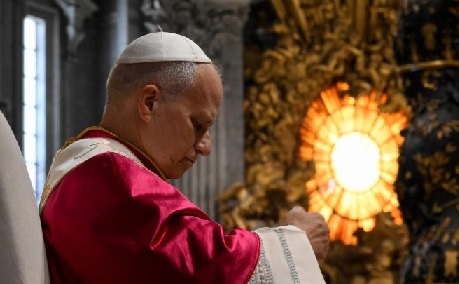
Pope Leo XIV gave this chilling reminder during the Prayer Vigil for Peace he led on Saturday evening in the Vatican, as he urged, “Let us listen to the voices of children!”

PRAYER CAN MOVE MOUNTAINS

People around the world joined the Holy Father in praying the Glorious mysteries of the Rosary, in person and remotely, with meditations from various Church Fathers, including St. Augustine of Hippo, St. John Chrysostom, and St. Ambrose of Milan. During the Rosary, faithful from different continents lit candles with the flame from the Lamp of Peace in Assisi, which burns perpetually at the tomb of St. Francis of Assisi.

The Pope thanked all those present and all those praying from afar for praying for peace, noting that their prayer is an expression of that faith which, as Jesus reminded, moves mountains. He began by recalling that: “War divides; hope unites. Arrogance tramples upon others; love lifts up. Idolatry blinds us; the living God enlightens.”

Yet, he reassured, “all it takes is a little faith, a mere ‘crumb’ of faith, in order to face this dramatic hour in history together — as humanity and alongside humanity.” He emphasized that prayer is not “a refuge in which to hide from our responsibilities, nor an anesthetic to numb the pain provoked by so much injustice,” but rather is “the most selfless, universal and transformative response to death.”

NOTHING CAN CONFINE US TO A PREDETERMINED FATE

In this context, he argued, “Nothing can confine us to a predetermined fate, not even in this world where there never seem to be enough graves, for people continue to crucify one another and eliminate life, with no regard to justice and mercy.”

Pope Leo remembered Saint Pope John Paul II’s adamant appeals for “no more war” and his insistence on our responsibility to do everything possible to counter it.

As we pursue peace, the Holy Father marveled how prayer teaches us how to act.

“In prayer,” Pope Leo marveled, “our limited human possibilities are joined to the infinite possibilities of God.” Moreover, he reflected, thoughts, words and deeds then “break the demonic cycle of evil and are placed at the service of the Kingdom of God. A Kingdom in which there is no sword, no drone, no vengeance, no trivialization of evil, no unjust profit, but only dignity, understanding and forgiveness.”

TRUE STRENGTH COMES FROM SERVING LIFE, NOT FROM DISPLAYS OF POWER

The Pope warned likewise against the idolatry of self and money.

“Enough of the display of power! Enough of war! True strength,” rather he said, “is shown in serving life.”

Thus the Pope encouraged, let us “unite the moral and spiritual strength of the millions and billions of men and women, young and old, who today choose to believe in peace, caring for the wounds and repairing the damage left behind by the madness of war.”

In this context, he recalled the traumatic effects on innocent children who suffer the terror of war, and called on humanity to hear their cry and protect them.

APPEAL TO THE LEADERS OF NATIONS TO PURSUE DIALOGUE AND MEDIATION

The Pope reaffirmed the “certainly binding responsibilities that fall to the leaders of nations.”

“To them we cry out,” Pope Leo said, “Stop! It is time for peace! Sit at the table of dialogue and mediation, not at the table where rearmament is planned and deadly actions are decided!”

Yet, he noted, an equally significant responsibility falls to all of us men and women from all over the world, to reject war, not only in word, but in deed.

Prayer calls us to leave behind whatever violence remains in our hearts and minds. Let us turn to a Kingdom of peace that is built up day by day — in our homes, schools, neighborhoods, and civil and religious communities.

Such a Kingdom, he added, is to counter polemics and resignation through friendship and a culture of encounter.

LET US BELIEVE AGAIN IN MODERATION AND GOOD POLITICS

“Let us believe once again in love, moderation and good politics. We must form ourselves and get personally involved, each following our own calling. Everyone has a place in the mosaic of peace!”

He went on to observe that the Rosary, like other ancient forms of prayer, united the faithful this evening in its steady rhythm built on repetition, pointing out that peace gains ground in the same way, “word by word, deed by deed, just as a rock is hollowed out drop by drop, or fabric woven stitch by stitch.”

The Holy Father reminded that these are the slow rhythms of life, a sign of God’s patience.

“We must not allow ourselves to be overwhelmed by the pace of a world that does not know what it is chasing. Rather,” he suggested, “we must return to serving the rhythm of life, the harmony of creation and healing its wounds.”

CHURCH INSTILLS OBEDIENCE TO GOD RATHER THAN ANY HUMAN AUTHORITY

The Pope therefore said we are to all return home having made a commitment to pray without ceasing and without growing weary, and to a profound conversion of heart.

Recalling the Church as a great people at the service of reconciliation and peace, the Pope pointed out that She advances without hesitation, “even when rejecting the logic of war may lead to misunderstanding and scorn.”

Moreover, he upheld, “She proclaims the Gospel of peace and instills obedience to God rather than any human authority, especially when the inherent dignity of other human beings is threatened by continuous violations of international law.”

Thus, the Pope expressed his hope that throughout the world, every community become a ‘house of peace,’ where one learns how to defuse hostility through dialogue, where justice is practiced and forgiveness is cherished. Now more than ever, he recognized, we must show that peace is not a utopia.

A PRAYER TO THE LORD WHO CONQUERED DEATH WITHOUT WEAPONS OR VIOLENCE

The Pope said that all brothers and sisters of every language, people and nation are one family that weeps, hopes and rises again, and thus, he again called on that family to embrace the appeal of his predecessor Pope, Saint John Paul II, to declare together, “No more war, a journey with no return; no more war, a vicious cycle of grief and violence.”

REPUBLICANS ARE SUPPORTIVE WHILE DEMOCRATS BLAST TRUMP FOR IRAN ‘WAR CRIMES’ THREAT

Several Members Of Congress Question President’s Fitness For Office After His Expletive-Laden Easter Sunday Message.

Several Democrats have condemned Donald Trump after the United States president renewed his threat to destroy Iran’s civilian infrastructure in a profanity-laden message.

Democratic legislators questioned the Republican’s mental stability after an Easter Sunday message in which he threatened to bomb Iran’s power plants and bridges, which legal experts said would amount to war crimes.

Congresswoman Yassamin Ansari, who is of Iranian descent, called for invoking the 25th Amendment to remove Trump from the presidency, suggesting he is unfit to serve.

The President of the United States is a deranged lunatic, and a national security threat to our country and the rest of the world,” Ansari wrote in a social media post.

For more than two weeks, Trump has been threatening to “obliterate” Iran’s civilian infrastructure if Tehran does not open the Strait of Hormuz.

But Sunday’s social media post – which coincided with the Easter holiday, included an expletive and invoked the name of Allah – was especially jarring to many of Trump’s critics at home and around the world.

Tuesday will be Power Plant Day, and Bridge Day, all wrapped up in one, in Iran. There will be nothing like it!!!” Trump wrote.

Open the F****n’ Strait, you crazy bastards, or you’ll be living in Hell – JUST WATCH! Praise be to Allah.”

Hakeem Jeffries, the top Democrat in the House of Representatives, called the message “disgusting and unhinged”.

Something is really wrong with this guy,” Jeffries wrote on X.

TRUMP’S THREATS AGAINST THE IRANIAN PEOPLE ARE MONSTROUS

It Is Not An Exaggeration To Say That The American President Has Threatened Genocidal Violence Against The People Of Iran.

The president marked Easter with more deranged threats against the country and people of Iran.

The American president gave Iran until 8pm eastern time on Tuesday to reopen the crucial shipping lane after earlier threatening to unleash “hell” in an expletive-laden social media post.

Tuesday will be Power Plant Day, and Bridge Day, all wrapped up in one, in Iran,” Trump wrote on Truth Social on Sunday. “There will be nothing like it!!! Open the Fuckin’ Strait, you crazy bastards, or you’ll be living in Hell – JUST WATCH! Praise be to Allah.”

The president is making explicit threats to commit massive war crimes against the civilian population. He means to inflict collective punishment on tens of millions of people because their government will not yield to his unhinged demands. He is treating the Iranian people as hostages, and he is threatening to shoot the hostages if he doesn’t get what he wants. The message the president has sent amounts to telling the Iranian people, “Trump, or I burn the country.”

It is not an exaggeration to say that the president is threatening genocidal violence against the people of Iran. Trump has referred to Iranians as “animals” in a chilling echo of Israeli officials’ statements at the start of the genocidal war in Gaza. He said this morning that a “whole civilization will die tonight, never to be brought back” if Iran does not capitulate. This is eliminationist language directed at a country of more than ninety million people. These are the words of a madman, and coming from the head of a nuclear weapons state they are terrifying.

It should be clear by now that this is a war on the Iranian people, and it was never going to be anything else. The aggressors want to wreck Iran and leave it in ruins. That should have been obvious from the start after what the Israeli government did to Gaza and is currently doing to Lebanon with Washington’s full support, but now it is undeniable.

Trump’s Iran policy has always been defined by collective punishment. His “maximum pressure” sanctions have impoverished the Iranian people and strangled their economy for the last eight years. Attacks on civilian infrastructure in his criminal war threaten the entire population with even greater deprivation and hardship. As ever, the destruction is the point. The president is not really trying to achieve anything. He simply wishes to punish and harm those that will not submit to him.

YOU SHOULD KNOW THE OPEN SECRET AT THE HEART OF THE WAR WITH IRAN

Israel’s Nuclear Weapons Program Was Secretly Developed With Financial And Diplomatic Support From The West. Its Nuclear Arsenal Remains A Leading Driver Of Conflict Across The Region.

The current American-Israeli war is the second war in less than a year declared by Israel and the USA, allegedly on the grounds of dismantling Iran’s nuclear capabilities.

While there is no documented evidence that Iran has a nuclear weapon or is close to developing one, there is another state in the Middle East whose nuclear arsenal exists as an open secret. That state is, of course, Israel, and its nuclear arsenal, although not officially recognized or confirmed, stands as one of the leading drivers of unrest throughout the region.

Israel’s history with nuclear weapons unfolded between secrecy, public tacit knowledge, and support, both materially and diplomatically, from the West, creating a playbook of strategic ambiguity around it still in place today.

At some point in the 1950s – it is impossible to pinpoint an exact date – David Ben Gurion, Israel’s first prime minister, launched the country’s nuclear project.

In the Negev desert, 152 kilometers from Tel Aviv and 90 kilometers from Jerusalem, out of indiscreet sight, the Shimon Peres Negev Nuclear Research Center, commonly referred to simply as “Dimona” complex, was built. Seventy years later, the facility is considered the most important pillar of Israel’s nuclear program, while officially it is a 26-megawatt thermal reactor.

To Israel’s aid in this mission came France who, according to historians, was seeking an alliance against Gamal Abdel Nasser, Egypt’s then-president.

Except for the French partner, everyone was kept in the dark about Dimona, including the American regime. In December 1960 Ben Gurion reported to the Israeli Knesset that the Dimona reactor was “a research reactor” which would serve “industry, agriculture, health and science”.

Washington did repeatedly question the nature of Israel’s actions in Dimona, and American officials even inspected the site on eight occasions between 1961 and 1969.

What they found was Israel’s articulated and well-designed propaganda stage: some sections of the nuclear plant were concealed, others were carefully disguised, hiding their real purpose.

But in the meantime, it is believed – impossible to claim certainty – that Israel finished building its underground separation plant by 1965, that it was producing weapons-grade plutonium by 1966 and assembling a nuclear weapon before the 1967 six-days war. It is also believed that in September 1979 Israel and apartheid era-South Africa conducted a joint nuclear test, known as the “Vela incident” from the American VELA 6911 satellite that detected a common sign of nuclear blast: an unexplained double flash of light.

Beliefs turned into facts in 1986. Mordechai Vanunu, a former Israeli nuclear technician, had been an employee at Dimona for eight years when he disclosed to the Sunday Times details and photographs of the nuclear research center. From this evidence, it was discovered that Israel ranked as the world’s sixth nuclear power and possessed as many as 200 atomic warheads. For his act of whistle-blowing, Mordechai Vanunu was imprisoned for 18 years, 11 of which he spent in solitary confinement. He was released in 2004, but he is still banned from travelling or speaking to foreign journalists.

There was, however, someone who was not caught by surprise: the American and UK governments, and, of course, France. In 1969, the then American president, Richard Nixon, and Israeli prime minister, Golda Meir, reached a “nuclear understanding“: questions would not be asked if Israel maintained silence and vagueness around its capabilities and avoided testing its nuclear weapons. Explained in Henry Kissinger’s, then national security adviser, own words: “While we might ideally like to halt actual Israeli possession, what we really want at a minimum may be just to keep Israeli possession from becoming an established international fact.”

It took an extra twenty years for the rest of the world to know the extent of Israel’s nuclear programs, and another extra twenty, until 2006, for the documents exposing the agreement between Nixon and Meir to be declassified. Still, in 2009, when asked whether any countries in the Middle East possessed nuclear weapons, Barack Obama, who was serving his first term as president of America, said he would not speculate.

Similarly, in 2005, a BBC investigation revealed that Britain had secretly supplied 20 tons of heavy water to Israel almost half a century before. Heavy water is so called because it goes through a laborious electrolysis process, which results in the water containing extra neutrons. At the time of the sale, this type of water was fundamental to the nuclear reactor Israel was building with French help.

One of the world’s “worst-kept secrets”, as it has been called by some scholars, that for Israel results in the ability to maintain its military standing in the Middle East and simultaneously avoid scrutiny. On the other side, for the West, silence on the matter is harder to explain. Gary Samore, President Obama’s top advisor on nuclear nonproliferation from 2009 to 2013, presented one reason behind the secrecy: “For the Israelis to acknowledge and declare it, that would be seen as provocative. It could spur some of the Arab states and Iran to produce weapons. So we like calculated ambiguity.”

There has been an attempt by the UN General Assembly to call on Israel to allow international oversight of its nuclear facilities in December 2014. The resolution was adopted, 161 to 5, on the premise that Israel is the only Middle Eastern country and one of the three countries in the world that have never signed the Treaty on the Non-Proliferation of Nuclear Weapons, together with India and Pakistan. Most importantly, of the world’s nine nuclear powers – America, Russia, China, France, the UK, Pakistan, and North Korea – Israel is the only one that does not officially admit having nuclear weapons. UN resolutions are non-binding, so it kept being business as usual for Israel.

To this day, there are estimates of Israel’s nuclear capacity: 90 warheads; 750–1110 kg plutonium stockpile, approximately – potentially enough for 187-277 nuclear weapons; 6 Dolphin-I and Dolphin II-class submarines believed capable of launching nuclear-armed cruise missiles; and Jericho III intermediate-range ballistic missiles with a potential range of 4,800 – 6,500 km.

Globally, these numbers would make Israel the second-smallest nuclear power after North Korea, but just as seventy years ago when Israel began building nuclear weapons, it remains impossible to know anything for a fact.

As events unfolded through the decades, the Israeli government maintained its stance of neither confirming nor denying its nuclear efforts, with some key rhetorical strategies that stayed the same. In the ’60s, Israel pledged “not to be the first country to introduce nuclear weapons into the Middle East”, an often-repeated line, also by Israeli Prime Minister Benjamin Netanyahu in 2011. Again in the ‘60 the expression “the Samson Option” was coined, a principle by which Israel would resort to nuclear retaliation in defence from an existential threat. In fact, although they never admitted the existence of a nuclear program, Israeli leaders have affirmed that nuclear weapons could be used if necessary.

That was the case of the 1973 war, when Egypt and Syria mounted a surprise attack. Anver Cohen, Israeli-American historian, professors and author, among others, of Israel and the Bomb, and other researchers have claimed that on that occasion Israel considered the nuclear option. More recently and less covertly, in 2016, Netanyahu claimed: “our submarine fleet acts as a deterrent to our enemies. They need to know that Israel can attack, with great might, anyone who tries to harm it”. And in November 2023, Haaretz reported that Israeli Heritage Minister Amichai Eliyahu said in a radio interview that dropping a nuclear bomb on the Gaza Strip was “an option”.

This long history and well-established narrative of secrecy and the avoidance of international inspection have succeeded to the extent that they remain in place today. Nonetheless, it is precisely because of Israel’s ambiguity that the Center for Arms Control and Non-Proliferation reads on its website that “the lack of clarity surrounding an Israeli nuclear weapons program is a key obstacle to establishing a weapons of mass destruction free zone in the Middle East”.

One of the many, often contradicting, motivations given by Trump to justify its joint attack with Israel on Iran was the danger represented by Iran’s weapons of mass destruction, for the sake of the region’s and the world’s safety. In his first statement on the war on February 28 he warned: “Just imagine how emboldened this regime would be if they ever had, and actually were armed with nuclear weapons as a means to deliver their message”. No imagination is needed. We have seen through the 70 years of Israel’s nuclear program what this threat looks like. And if the goal is to secure a nuclear-free region, then it is long overdue that we start talking about Israel’s nuclear arsenal.

Free speech is under attack—especially when the current American-Israeli war is the second war in less than a year declared by Israel and the USA, allegedly on the grounds of dismantling Iran’s nuclear capabilities.

While there is no documented evidence that Iran has a nuclear weapon or is close to developing one, there is another state in the Middle East whose nuclear arsenal exists as an open secret. That state is, of course, Israel, and its nuclear arsenal, although not officially recognized or confirmed, stands as one of the leading drivers of unrest throughout the region.

One of the many, often contradicting, motivations given by Trump to justify its joint attack with Israel on Iran was the danger represented by Iran’s weapons of mass destruction, for the sake of the region’s and the world’s safety. In his first statement on the war on February 28th he warned: “Just imagine how emboldened this regime would be if they ever had, and actually were armed with nuclear weapons as a means to deliver their message”. No imagination is needed. We have seen through the 70 years of Israel’s nuclear program what this threat looks like. And if the goal is to secure a nuclear-free region, then it is long overdue that we start talking about Israel’s nuclear arsenal.

Free speech is under attack—especially when it comes to Palestine.

TRUMP KEEPS EXPANDING HIS SECRET WARS ON THE WORLD

An Analysis Reveals That The “Peace” President Has Embroiled America In More Than 20 Military Interventions, Armed Conflicts, And Wars.

President Donald Trump talks endlessly of “peace.” He ran for office promising to keep the United States out of conflicts, claims to be a “peacemaker,” has campaigned for a Nobel Peace Prize, and founded a so-called Board of Peace. “Under Trump we will have no more wars,” he said on the campaign trail in 2024. Yet Trump has immersed America in constant conflict, outpacing even other presidential warmongers like Richard Nixon, George W. Bush, and Barack Obama.

The White House and Pentagon won’t tell the American people where America is at war, and Trump has never gone to Congress for war authorization. But an analysis reveals that Trump has embroiled America in more than 20 military interventions, armed conflicts, and wars during his five-plus years in the White House. Due to a lack of government transparency, obscure security cooperation, and carveouts baked into the American Code — like the 127e authority enacted in the wake of the September 11 attacks, and the covert action statute that enables the CIA to conduct secret wars — the actual number could be markedly higher.

During his two terms in office, Trump has overseen armed interventions and military operations — including drone strikes, ground raids, proxy wars, 127e programs, and full-scale conflicts — in Afghanistan, Central African Republic, Cameroon, Ecuador, Egypt, Iran, Iraq, Kenya, Lebanon, Libya, Mali, Niger, Nigeria, North Korea, Pakistan, the Philippines, Somalia, Syria, Tunisia, Venezuela, Yemen, and an unspecified country in the Indo-Pacific region, as well as attacks on civilians in boats in the Caribbean Sea and Pacific Ocean. More than 6,500 American Special Operations forces’ “operators and enablers” are currently deployed in more than 80 countries around the world. And during its second term, the Trump administration has also bullied Panama and threatened Canada, Colombia, Cuba, Greenland (perhaps also Iceland), and Mexico.

Under the American Constitution, it’s Congress that has the authority to declare war, not the president, pointed out Katherine Yon Ebright, counsel in the Brennan Center’s Liberty and National Security Program.

Congress has not authorized conflicts in this wide array of contexts, and indeed many lawmakers — to say nothing of members of the public — would be surprised to learn that hostilities have taken place in many of these countries,” Ebright said. “Congressional authorization isn’t just a box-checking exercise: It’s a means of ensuring that the solemn decision to go to war is made democratically and accountably, with a clear purpose and goal that the American people can support.”

Despite the fact that America has not declared war since 1941, its military has fought near-constant wars from Korea to Vietnam from the 1950s through the 1970s to Afghanistan and Iraq in the 21st century, as the executive branch has come to dominate the government and Congress has abdicated its constitutional duty to declare war.

For years, the Pentagon has even attempted to define war out of existence, claiming that it does not treat 127e and similar authorities as authorizations for the use of military force. In practice, however, Special Operations forces have used these authorities to create and control proxy forces and sometimes engage in combat alongside them. Recent presidents have also consistently claimed broad rights to act in self-defense, not only of American forces but also for partner forces.

The Trump administration has even claimed the full-scale conflict in Iran is something other than what it is. Earlier this month, Undersecretary of Defense for Policy Elbridge Colby refused to call it a war. “I think we’re in a military action at this point,” he told lawmakers.

Trump routinely refers to the conflict with Iran as a war, but he has also cast it as an “excursion.” Trump has also erroneously claimed that if he doesn’t call the conflict with Iran a “war,” it circumvents Congress’s constitutional authority.

We have a thing called a war, or as they would rather say, a military operation. It’s for legal reasons,” he said on Friday. “I don’t need any approvals. As a war you’re supposed to get approval from Congress. Something like that.”

Earlier This month, Special Operations Command chief Adm. Frank M. Bradley told the House Armed Services Committee’s Subcommittee on Intelligence and Special Operations that secret-war capabilities were key for the United States.

This environment places a premium on forces capable of operating persistently inside contested spaces, below the threshold of armed conflict,” he said. “Small footprints are necessary to enable denial strategies, strengthen allied resilience, and contribute to deterrence without triggering escalation, and to counter illicit and malign activity without large-scale military presence.”

Bradley claimed America’s enemies “blur the lines between competition and conflict,” but this is precisely what America has done for decades, including numerous secret wars during both Trump terms. The United States has waged unconstitutional and clandestine conflicts through a variety of mechanisms. The covert action statute, for example, provides the authority for secret, unattributed, and primarily CIA-led operations that can involve the use of force. It has been used during the forever wars, including under Trump, to conduct drone strikes outside areas of active hostilities. It was apparently employed in the first American strike on Venezuela in late 2025 — a prelude to a war, days later, that led to the kidnapping of that country’s president, Nicolás Maduro, by American Special Operations forces.

The 2001 Authorization for Use of Military Force, which was enacted in the wake of the 9/11 attacks and has been stretched by successive administrations to cover a broad assortment of terrorist groups — most of which did not exist on September 11 — has been used to justify counterterrorism operations, including ground combat, airstrikes, and support of partner militaries, in at least 22 countries, according to a 2021 report by Brown University’s Costs of War Project.

Under Trump, even this signature post-9/11 workaround for war has been eschewed for something more clandestine. Top Pentagon leadership wanted to keep so-called “advise, assist and accompany” or “AAA” missions — which can be indistinguishable from combat — under wraps during Trump’s first term. This led then-Defense Secretary James Mattis to order American operations in Africa to be kept “off the front page,” a former senior American official told the International Crisis Group.

But the bid to keep Trump’s other African wars secret imploded during a May 2017 AAA mission when Navy SEAL Kyle Milliken was killed and two other Americans were wounded in a raid on an al-Shabab camp in Somalia. The Pentagon initially claimed that Somali forces were out ahead of Milliken — American troops are supposed to remain at the last position of cover and concealment where they remain out of sight and protected — but that fiction fell apart, and the truth emerged that he was, in fact, alongside them.

This was followed by an October 2017 debacle in Tongo Tongo, Niger, where ISIS fighters ambushed American troops, killing four American soldiers and wounding two others. The American regime initially claimed troops were providing “advice and assistance” to local counterparts. In truth, until bad weather prevented it, the ambushed team was slated to support another group of American and Nigerien commandos attempting to kill or capture an ISIS leader as part of Obsidian Nomad II, another 127e program.

But the bid to keep Trump’s other African wars secret imploded during a May 2017 AAA mission when Navy SEAL Kyle Milliken was killed and two other Americans were wounded in a raid on an al-Shabab camp in Somalia. The Pentagon initially claimed that Somali forces were out ahead of Milliken — American troops are supposed to remain at the last position of cover and concealment where they remain out of sight and protected — but that fiction fell apart, and the truth emerged that he was, in fact, alongside them.

This was followed by an October 2017 debacle in Tongo Tongo, Niger, where ISIS fighters ambushed American troops, killing four American soldiers and wounding two others. The American regime initially claimed troops were providing “advice and assistance” to local counterparts. In truth, until bad weather prevented it, the ambushed team was slated to support another group of American and Nigerien commandos attempting to kill or capture an ISIS leader as part of Obsidian Nomad II, another 127e program.

During Trump’s first term, American Special Operations forces conducted at least 23 separate 127e programs across the world. Previous reporting has documented many 127e efforts in Africa and the Middle East, including a partnership with a notoriously abusive unit of the Cameroonian military, also during Trump’s first term, that continued long after its members were connected to mass atrocities. In addition to Cameroon, Niger, and Somalia, the American regime has conducted 127e programs in Afghanistan, Egypt, Iraq, Lebanon, Mali, Syria, Tunisia, Yemen, and an undisclosed country in the Indo-Pacific region.

During the global war on terror, the Department of Defense built out its capacity, and secured legal authorities, to operate ‘by, with, and through’ foreign militaries and paramilitaries,” Ebright said, noting that these authorities had been designed for countering al-Qaeda but had led to led to combat against groups that had not been debated and approved by Congress. “These smaller-scale, unauthorized hostilities through or alongside foreign partners may seem quaint compared to the Iran War and other recent public and persistent hostilities, but for years they deepened the perception that the president may use force whenever and wherever he pleases, even without specific congressional authorization.”

During the global war on terror, the Department of Defense built out its capacity, and secured legal authorities, to operate ‘by, with, and through’ foreign militaries and paramilitaries,” Ebright said, noting that these authorities had been designed for countering al-Qaeda but had led to led to combat against groups that had not been debated and approved by Congress. “These smaller-scale, unauthorized hostilities through or alongside foreign partners may seem quaint compared to the Iran War and other recent public and persistent hostilities, but for years they deepened the perception that the president may use force whenever and wherever he pleases, even without specific congressional authorization.”

America’s punishing war on Iran has ground on for over a month without a clear definition of victory, a plan for the aftermath, or coherent strategy behind bellicose rhetoric and shifting claims, most recently that the American regime is fighting a regime change war and will possibly seize Iran’s oil.

We’ve had regime change if you look already because the one regime was decimated, destroyed, they’re all dead,” Trump said on Sunday, referring to top ranking officials killed in the war including the late Supreme Leader Ayatollah Ali Khamenei. “The next regime is mostly dead.”

CAN THERE BE AN EMPIRE WITHOUT LIBERTY?

Since The Beginning Of The War, President Donald Trump Has Touted Dismantlement Of The Iranian Government As The American Endgame.

Even as American officials negotiate with their Iranian counterparts to end the fighting and restore stability to world energy markets, Trump says he still wants to see a “very serious form of a regime change” in the ultimate peace deal.

This imperial hubris is unworthy of the president of a federal republic and would cause the Founding Fathers to cringe.

While Thomas Jefferson and his contemporaries were often excited about continental prospects for the thirteen former British colonies, the “empire of liberty” as Jefferson called the American experiment was based on free and equal states and not a unitary nation-state with ambitions of directing the governments of the world.

The Founders, of course, were aware of the novelty of their experiment and that its success could provide hope for millions. In the Philadelphia Convention, James Madison asserted that “it was more than probable we are now digesting a plan which in its operation would decide for ever the fate of Republican Government.” Benjamin Franklin observed that if republican government failed in the United States, “mankind may hereafter from this unfortunate instance, despair of establishing Governments by Human wisdom and leave it to chance, war and conquest.” In his first inaugural address, George Washington declared his belief that “preservation of the sacred fire of liberty, and the destiny of the Republican model of Government, are justly considered as deeply, perhaps as finally staked, on the experiment entrusted to the hands of the American people.”

The influence the Founders sought over other nations was influence by example. They believed that political societies across the globe would seek to emulate American principles of limited government, federalism, and the rule of law. They did not expect that the chief executive, without input from the legislative branch, would bomb foreign countries and demand that new regimes be erected.

Each day the United States looks less like an “empire of liberty” and more like a plain old empire in the mode of the Romans, Ottomans, and Mongols.

Depending on how one counts, the United States maintains upwards of 750 military bases overseas. Scholars estimate that these bases “constitute 95 percent of all the military bases any country in the world maintains on any other country’s territory.” Granted, some of these instillations are tiny with few personnel. Nonetheless, the 95% figure is shocking.

Over one hundred years ago, the stalwart anti-imperialist and Yale sociologist William Graham Sumner warned that American interventionism abroad would put our system of government at risk. Just as the United States was about to go to war against Spain, Sumner cautioned that by taking away Spanish possessions on the ground that Spain was failing in her colonial mission in Cuba, the United States would “shrivel up into the same vanity and self-conceit of which Spain now presents an example.” If the United States truly believed in liberty, then Sumner suggested that it should tend to its own affairs and leave other peoples “to live out their own lives in their own way.” What would be in store for the United States if it succumbed to the temptations of interventionism? According to Sumner, “war, debt, taxation, diplomacy, a grand governmental system, pomp, glory, a big army and navy, lavish expenditures, political jobbery—in a word, imperialism.”

Listening to President Trump’s bluster as he asks Congress for $200 billion to continue his war of regime change in Iran, it is hard to disagree with Sumner that we have traded our peaceful federal republic for an avaricious empire. Congress must deny this request. The United States should serve as an empire of liberty, in Jefferson’s words, and leave the vanity of imperialism for despotic powers.

THE MEDIA WAR FROM TRUMP

The American Government Is Waging An Illegal, Congressionally Unauthorized War On Iran. Thirteen American Soldiers Are Formally Confirmed Dead So Far. Over $11 Billion Of America’s Money Has Been Spent In Three Weeks.

While the primary concern of senior administration officials is that television stations are using the wrong headlines.

On March 13, Pete Hegseth—the former Fox News host who renamed the Defense Department and whose theology holds that God is personally invested in American airpower over Tehran—stood in front of the Pentagon press corps and delivered a media workshop. A headline reading “Mideast War Intensifies” was not acceptable, he explained. He had a better suggestion: “Iran Increasingly Desperate.” A “patriotic press” would understand the difference. The next day, FCC Chairman Brendan Carr — an author of Project 2025, appointed by Donald Trump specifically for this work — posted a warning to broadcasters that those running “hoaxes and news distortions” should “correct course before their license renewals come up.” Trump endorsed it on Truth Social, calling the networks “Corrupt and Highly Unpatriotic.” The Foundation for Individual Rights and Expression called Carr’s warning exactly what it was: “authoritarian.”

None of this is surprising. And that is precisely the problem—not the Trump administration specifically, but the degree to which the infrastructure for state control of information is being normalized, codified, and institutionalized across governments that could not agree on the time of day. Trump’s press war is the visible part. What lies beneath it is a Western-wide architecture of information control that will outlast this administration and every one that follows it.

The harder instrument at the White House’s disposal is NSPM-7, the National Security Presidential Memorandum Trump signed on September 25, 2025, titled “Countering Domestic Terrorism and Organized Political Violence.” It tasked FBI Joint Terrorism Task Forces with investigating and disrupting organizations engaged in what the administration classifies as political violence and intimidation. It directed the Treasury Department and IRS to trace and freeze financial networks supporting those organizations. On its face: counterterrorism. In its text: a different matter.

NSPM-7 specifically identifies ideological positions—”anti-Americanism, anti-capitalism, and anti-Christianity,” “extremism on migration, race, and gender,” opposition to what it calls “traditional American views on family, religion, and morality”—as having animated the political violence it seeks to counter. Attorneys at Arnold & Porter noted that the memorandum deploys post-9/11 counterterrorism tools—tools with no federal crime of “domestic terrorism” attached to them—against a category of organizations defined substantially by their beliefs. The Brennan Center found the memo’s reach extended to “labor organizers, socialists, many libertarians, those who criticize Christianity, pro-immigration groups” and essentially anyone the administration considers insufficiently American. The ACLU called it an effort “to investigate and intimidate his critics.” Congressman Ro Khanna (D-CA) called it “one of his most dangerous power grabs yet.” The NYCLU was more precise: NSPM-7 could make “First Amendment protected speech the basis for beginning law enforcement investigations.”

Carr targets the newsrooms. NSPM-7 targets the civil society—the donors, the nonprofits, the advocacy organizations—that sustains independent journalism and challenges official narratives. They are not separate instruments. They are a pincer.

Here is what American commentary on Trump’s media wars consistently omits: the formal institutional development of information control as a military and security doctrine has been underway in Western institutions for years, and it has nothing to do with Trump.

NATO’s Allied Command Transformation—the alliance’s concept development body, headquartered in Norfolk, Virginia—has been building what it formally designates the Cognitive Warfare Exploratory Concept since 2020. The concept originated in an ACT-commissioned study by François du Cluzel, a former French military officer, which proposed that the human brain constitutes NATO’s “sixth domain of operations”—alongside land, sea, air, space, and cyber. The study’s framing was explicit: “[T]he brain will be the battlefield of the 21st century.” NATO ACT’s published definition of cognitive warfare is “an unconventional form of warfare that uses cyber tools to alter enemy cognitive processes, exploit mental biases or reflexive thinking, provoke thought distortions, influence decision-making and hinder actions.” Its stated aim, in the alliance’s own words, includes “proactively shaping the information environment.”

NATO’s cognitive warfare program is framed as defensive—protecting member-state populations from adversary manipulation, primarily Russia and China. That framing is not dishonest; Russian information operations are real and have caused genuine damage to democratic processes. But a parliamentary question raised in the European Parliament in 2022 identified the structural problem that the doctrine does not resolve: the tools for protecting a population from cognitive manipulation are identical to the tools for conducting it. A military concept built around “shaping the information environment” and exploiting cognitive biases does not come with a switch that limits its use to foreign adversaries. Academic analysis published in Frontiers confirmed that the final cognitive warfare doctrine was expected to be integrated into official NATO doctrine by late 2024. The alliance of thirty-two governments is now formally in the business of cognitive operations, with a doctrine that will be available to every administration that follows, in every member state, indefinitely.

This is a significant development. It has received almost no public attention commensurate with its implications.

On May 20, 2025, the European Union did something that would have been treated as a scandal in any previous decade of European politics. The EU Council adopted Council Decision CFSP 2025/966, the seventeenth package of sanctions against Russia’s “destabilising activities.” Among the twenty-one individuals added to the list—subject to asset freezes, funding prohibitions, and potential travel bans—were two German citizens: Thomas Röper, who runs the blog Anti-Spiegel, and Alina Lipp, who operates the YouTube channel Neues aus Russland. Both are bloggers and journalists. Both hold German citizenship. Both were sanctioned by an unelected Council body, under a proposal signed by High Representative Kaja Kallas, without judicial review, for content the EU determined was aligned with Russian state interests.

This is worth sitting with. The European Union, which regularly issues statements about press freedom in Hungary and Turkey, quietly sanctioned two of its own citizens for journalism—without a trial, without a judge, without any of the procedural protections that European legal traditions supposedly guarantee. The legal framework that enabled this—the parent Decision 2024/2643—allows listing of anyone “responsible for, supporting, or involved in” actions that “undermine or threaten democracy, the rule of law, stability or security in the Union.” The definition is broad by design. Legal scholars including Nico Krisch have noted that absent transparent evidentiary standards, the criteria can reach virtually any dissident voice that institutional authorities decide is harmful.

Jim Bovard noted earlier this year that the German government’s approach to speech is “freedom of speech except for ideas that politicians and government contractors and nonprofit activists don’t like.” CFSP 2025/966 is what that approach looks like when it is formalised into EU foreign policy law and equipped with financial weapons.

The EU’s broader framework for managing information is built around what the European External Action Service calls Foreign Information Manipulation and Interference (FIMI). Academic researchers publishing in Media and Communication in 2025 documented how the EEAS deliberately chose “FIMI” over “disinformation” precisely because the FIMI concept is “versatile enough to be applied to any narrative perceived as harmful.” The shift from content-based to behaviour-based classification matters. FIMI is defined not by the falseness of what is said but by its “manipulative” character, a determination left to the classifying authority. When the European External Action Service is the classifying authority, the European External Action Service decides what counts as manipulation.

The EU also granted itself, under CFSP 2025/963—adopted the same day as 2025/966—the power to suspend broadcasting licences of Russian media outlets. The symmetry with Brendan Carr’s FCC threats is not accidental. It is the same logic applied by different hands.

Trump and the EU’s foreign policy apparatus dislike each other intensely. This article is not arguing they are coordinating. What it is arguing is more troubling: they are converging on the same conclusion independently, because that conclusion serves the interests of every government that reaches it.

The conclusion is the information environment is a security domain. Narratives that challenge government policy or undermine institutional legitimacy are, by that logic, security threats. Institutions with authority to manage security threats may therefore claim authority over information. The mechanisms vary—FCC licensing leverage, NSPM-7 terrorism designations, EU sanctions, NATO cognitive warfare doctrine—but the claim is uniform. The state should determine what constitutes acceptable public discourse, and it should have tools to act against those who fall outside that boundary.

This is not a new instinct. Every government in history has had it. What is new is the sophistication and durability of the infrastructure now being built to act on it. The chilling effect of a licensing threat. The advertiser pressure that follows a presidential denunciation. The asset freeze that makes independent journalism economically impossible without a single criminal charge. The algorithmic suppression that platforms apply when content is flagged under a FIMI framework. No editor needs to be arrested. No newsroom needs to be raided. The journalist learns that continued operation is contingent on behaviour the state finds acceptable, and adjusts accordingly.

Reporters Without Borders ranked the United States 57th globally on press freedom in 2025 its lowest position in the index’s history — classifying the environment for American journalism as “problematic.” That was before Brendan Carr told broadcasters they would lose their licenses for covering an undeclared war in terms the administration disliked. The 2026 numbers will be lower.

The apparatus being assembled right now—across administrations that agree on nothing else—will be inherited by every government that follows. States do not voluntarily relinquish instruments of information control once those instruments are built and normalised. They do not return the power to define manipulation to the people who might use it against them. The question is not whether this machinery can be dismantled. The question is whether anyone in a position to resist it has the honesty to call it what it is: censorship infrastructure, flying the flag of security.

Design a site like this with WordPress.com
Get started