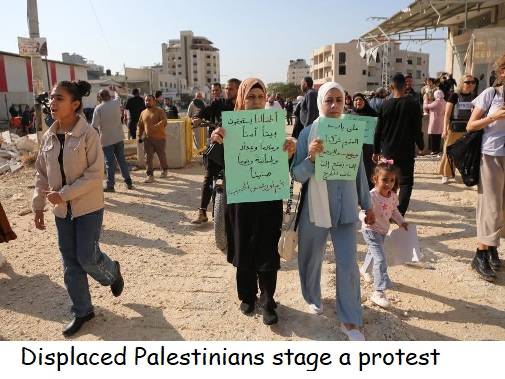
Palestinians Displaced From Refugee Camps In The Northern West Bank Are Demanding To Return To Their Homes After An Israeli Military Takeover Of The Camps.
They fear that proposed American plans for rebuilding the camps will completely erase them.
It has been well over 200 days since the people of the Tulkarem, Nur Shams, and Jenin refugee camps were forced out of their homes by the Israeli army during its offensive in the northern West Bank dubbed “Operation Iron Wall.” Over 40,000 Palestinians from these camps have been displaced for the past eleven months, many of them living in deplorable conditions, and without a clear return to their homes on the horizon.
These thousands of families have been displaced within their own cities, and are totally reliant upon community resources for survival. Israeli forces are now stationed in the now-depopulated camps, and has kept them empty as it aims to uproot armed Palestinian resistance groups, which were based in the camps before the Israel’s operation.
Last Thursday, Human Rights Watch released a report based on its analysis of satellite imagery, concluding that about 850 buildings in the three refugee camps were destroyed or sustained heavy damage within six months of the start of the Iron Wall offensive in January. Human Rights Watch stated that “Israeli forces committed forcible displacement in violation of the law of occupation under international humanitarian law that amount to war crimes.”
The conditions imposed on Palestinians from these camps impact every aspect of their daily lives, adding to the humanitarian burden on the limited resources of the cities and their community.
“The most obvious impact is currently on the education of children, who used to go to the UNRWA schools in the camps, which have now been closed down,” Hussein Sheikh Ali, a social activist in Tulkarem, said. “Thousands of children haven’t attended a day of school for 10 months.”
“After a lot of waiting, some children in primary school age were relocated to government schools in the afternoon, but not middle or high school students,” he added. “This is creating a growing crisis of young people without school in the city.”
Another side of the crisis is health, Ali continues. “Thousands of chronic disease patients depended on UNRWA health centers, and they have lost that support, especially the elderly,” he added. “But beneath the obvious sides of the crisis, there is the increasing poverty of hundreds of families from the camps, who depend on working permits in Israel and whose permits have been revoked by the occupation, as well as those who had small shops and businesses in the camps who also lost everything.”
“In our association, the Wadi Al-Hawareth Charity Association, we have been distributing over 1,000 hot meals to displaced families every day,” Ali noted. “We rely on donations from the community and local donors, but the need is much greater than our resources, and recently we reduced our distribution to once every two days to cover as much need as possible.”
Ali stresses that the current response by local civil society to the needs created by the displacement of the camps “is not sustainable in the long term, and all local associations act in the hope that there will be a solution soon.”
Meanwhile, displaced Palestinians continue to struggle to maintain their social cohesion while responding to their needs. Najat Butmeh, a displaced Palestinian from the Jenin camp, who is a school teacher and the director of the “Warm House” women and children’s center in the camp, said that “the most important thing that displaced people from Jenin refugee camp are holding onto is their sense of community, staying in touch with each other, and trying to help each other out.”
 Hidden History -- In The Making