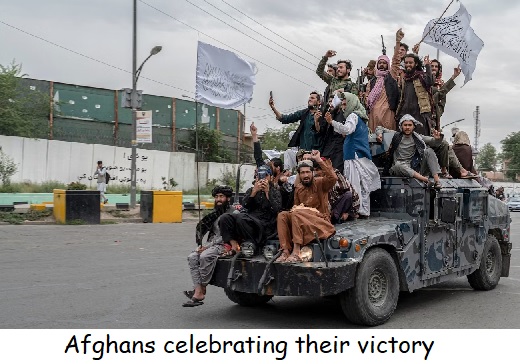
President Donald Trump Wants Back The Bagram Air Base. That Is Not Going To Happen Without Starting The War Over Again. There Is No Good Reason For Wanting To Take Over That Air Base.
No one ever accused President Donald Trump of being a systematic thinker. Were not the potential consequences so great, the obvious response to his demand on Afghanistan’s ruling Taliban to “return” Bagram air base would be uproarious laughter.
It’s been more than four years since the Biden administration withdrew American forces from the central Asian state. The departure, just a few weeks shy of the 20-year anniversary of the arrival of American forces, made Washington’s 1975 exit from Saigon look orderly. However, the American military’s retreat was long overdue and completed the accord negotiated by Trump during his first term. Some of the insurgents had been fighting since the Taliban first emerged in 1994, and even before, against Soviet occupiers. Demanding that the victors accept a permanent American military presence would have killed any agreement, turning Afghanistan into a truly forever war.
Since then, the people of Afghanistan have suffered under the Taliban’s oppressive, theocratic rule. However, for many the end of the war was still a relief. While Americans like to view themselves as liberators, many Afghans saw them as anything but that. Explained interpreter Baktash Ahadi:
“Virtually the only contact most Afghans had with the West came via heavily armed and armored combat troops. Americans thus mistook the Afghan countryside for a mere theater of war, rather than as a place where people actually lived. U.S. forces turned villages into battlegrounds, pulverizing mud homes and destroying livelihoods.”
Unsurprisingly, Ahadi continued, “any sympathy for the West evaporated in bursts of gunfire.” Compared to the distant, corrupt, and incompetent Kabul government and its American ally, the Taliban became the lesser of two evils.
Even critics of the latter welcomed peace. After visiting the country shortly after the insurgents’ victory, journalist Anand Gopal observed that “the biggest thing I noticed on the ground is just how tired people were of fighting.” Most Americans had no idea. Added Gopal:
“The first thing people say when I call them these days is, “Thank God everything’s peaceful.” They’re not even thinking about the kinds of things we think of, like, “Who’s going to be in the government? Are the Taliban going to be sharing power? What’s the role of women?” Right now, the people I’m talking to, men and women, the thing they say is, “Well, thank God it’s just peaceful”.”
Although the American regime quickly defeated the Taliban militarily, the Bush administration arrogantly demanded total victory, refusing to negotiate the group’s formal capitulation, and opposition gradually returned. Then, as America’s position deteriorated, military and political officials alike hid the facts from the public, policymakers, and perhaps even themselves. The Washington Post’s Craig Whitlock wrote a devastating critique of the war, detailing how “senior U.S. officials failed to tell the truth about the war in Afghanistan …, making rosy pronouncements they knew to be false and hiding unmistakable evidence the war had become unwinnable.” Although Trump failed to override military opposition to a withdrawal, he appeared to understand the impossibility of victory and eventually negotiated to end the war, though he left the pull-out to his successor.
But now he wants an American military restoration.
Peaceful engagement with Afghanistan makes sense. Toward that end the new administration apparently has met with the Taliban, which announced that the governments discussed “bilateral relations between the two countries, issues related to citizens, and investment opportunities in Afghanistan.” Continuing to treat Kabul as an enemy achieves nothing. The Taliban has triumphed and is now looking for partners, including China and Russia. Engagement is more likely than isolation to encourage the Taliban to moderate its rule.
Alas, Trump is making military demands that treat Afghanistan like a captive satrapy. But the Taliban, which defeated the American regime, has no reason to grant Washington any favors. The latter does not recognize the Afghan government, sanctions the nation’s leadership, and continues to freeze central bank assets, which affects private Afghans as well as their rulers. America’s forces had barely made it home before Washington’s War Party, led by the ever-belligerent Sen. Lindsey Graham (R-SC) and then-Rep. Mike Waltz (R-FL), more recently Trump’s discredited national security adviser turned United Nations ambassador, were campaigning to restart the war. Regime opponents have lobbied Congress to support a new armed opposition, though so far without much success. Why would Kabul invite Americans still acting like an enemy, to return with guns potentially blazing?
 Hidden History -- In The Making