Enraged By The 2005 Withdrawal, The National-Religious Camp Worked To Brand Territorial Concession As A Disaster — With Ethnic Cleansing As The Only Solution.
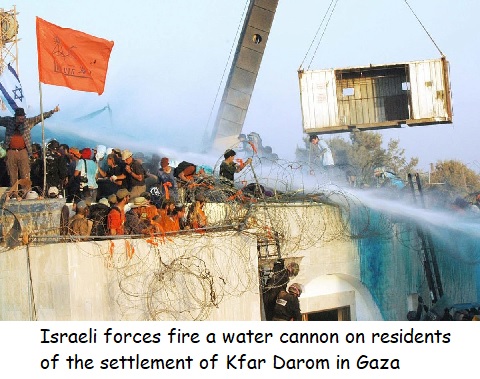
In August 2005, when Israel implemented its “unilateral disengagement plan” in Gaza, it came as a rude jolt to the settler movement. The plan entailed the removal of 21 settlements in the Gaza Strip and an additional four in the northern West Bank, with a total of approximately 9,000 settlers relocated. The atmosphere in the country at the time felt as if a tipping point had been reached: it was Prime Minister Ariel Sharon, a stalwart of the Israeli right, who ordered the withdrawal of the Israeli military and illegal settlements from occupied Palestinian territory.
Twenty years later, how Israel conducted the withdrawal of its settlements from Gaza — and subsequently narrated the fallout — can be understood as a critical juncture in the demise of the two-state paradigm. It was also a harbinger of what is now replacing it: not just separating from the Palestinians, relegated to shrinking Bantustans, but annihilating and erasing them.
In the decade after the withdrawal, Israel’s right-wing national-religious camp, with Likud at the helm, succeeded in deeply embedding the idea that a withdrawal of settlements could never be repeated. This presaged the dominance since October 7th of what were long considered extreme positions, where Israeli officials openly advocate for the completion of the ethnic cleansing of Palestinians that was left unfinished in the original Nakba of 1948. And after the Hamas-led attacks, it was the national-religious camp that was the quickest to recalibrate and identify a moment of opportunity.
Very early on, the notion took hold that, tragic as it was, October 7th was a sign of “messianic times” and an “era of miracles” — a divine intervention that portends the extension of Jewish sovereignty across the biblical Land of Israel and the coming of the messiah. That belief has since been invoked by leaders of the Jewish Power and Religious Zionism factions, most notably by Settlements and National Missions Minister Orit Strook, as well as by rabbinical chaplains in the Israeli army, media commentators, and others.
The Likud Party and the political establishment that had been busy advancing the de facto annexation of the West Bank, with settlers conducting pogroms in West Bank villages and intensifying land theft, now saw an opportunity to reorder priorities. Gaza no longer had to be conceded; it could be resettled. Twenty-first century ethnic cleansing could be taken for a test ride in Gaza before being fully unleashed in the West Bank.
“Gaza First” once referred to the initial implementation of the original Israel-PLO “Declaration of Principles”, where the Palestinian Authority (PA) assumed its first self-governing role in what were defined as the Palestinian areas of Gaza, as well as in the West Bank city of Jericho. The second iteration of “Gaza First” referred to Sharon’s disengagement plan, with the optimistic take that Gaza would be the first of many sites of Israeli withdrawal.
But today, “Gaza First” has taken on a new meaning: Gaza as the opening site of messianic redemption and Palestinian annihilation, or in the current Israeli parlance, “total victory.” It is no surprise that the Israeli human rights group B’Tselem warns in its recent report that what is happening in Gaza is already being planned for the West Bank.
The path from 2005 to 2025 was not preordained, but the contours are now clear — the consequences of political choices that were made then and now need to be unmade or reshaped. Describing this trajectory brings into sharper relief the need for a new political vision for all of historic Palestine, one that will have to come from outside the Zionist consensus.
Palestinians will need to take a central role in defining that vision, and will have to do so outside of the rigid constraints of the PA that sustains itself on the status quo. Whether Israeli politics and society can move beyond this genocidal moment is crucial, and will largely depend on the interplay between internal domestic dynamics and external pressure. But as long as the latter is so limited and absent, the former is unlikely to meaningfully change.
 Hidden History -- In The Making