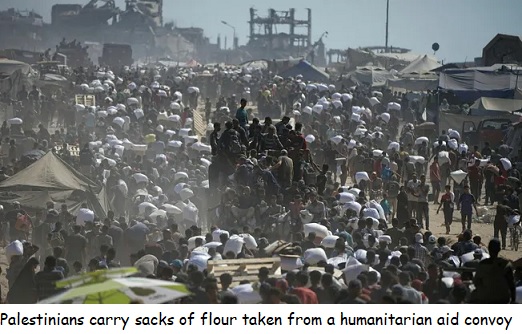
Despite IDF ‘Examinations,’ There Is Not Enough Food In The Gaza Strip. Aid Does Not Reach The Weakest Members Of The Society Due To Israel’s Genocidal Intent.
The Israel Defense Forces public relations apparatus officially stated last week that according to an examination they conducted, there is no hunger in Gaza.
Anyone reading the headlines touting their claims might assume that the IDF entered Gaza and analyzed the situation of the besieged population. This is obviously not the case. However, this is indeed what the IDF should now do: Conduct a thorough examination of the hunger situation in Gaza, especially in areas where fundamental difficulties in obtaining information about the population’s condition exist, in order to enable effective aid distribution.
The Association for Civil Rights in Israel approached the IDF with this demand once receiving reports on the scope of the disaster. Despite claiming otherwise, nothing was done. Those who did conduct thorough examinations are independent and experienced professional organizations, such as the Integrated Food Security Phase Classification (IPC), and they determined that Gaza is already suffering from severe hunger.
The IDF, instead, surveyed the growing list of the dead published by Gaza’s Ministry of Health. According to this data, at least 170 people died in the Gaza Strip since the beginning of July from causes related to malnutrition. The IDF then published headlines stating that in many of the cases those who died were suffering from pre-existing conditions.
Indeed, death from malnutrition can be related to a variety of social and physical risk factors and vulnerabilities, including pre-existing medical conditions that hunger exacerbates to the point of death. In Gaza, the risk of malnutrition can also be related to extreme poverty, physical weakness that precludes searching for food, being in areas that the army cut off from other areas, and more. Though these individuals may be at-risk, they likely would not have died now had they received basic food and healthcare in minimal quantities. Are their lives worth less than healthy people?
Let us be clear: In the Gaza Strip there is not enough food. The food that exists is not varied and nutritious, and is not available to the weakest populations. It is not available in sufficient quantities to the sick and disabled, it is not available to pregnant and nursing women, and to women and girls in general. It is not available to children who have been orphaned or left to care for themselves. It is not available in areas such as the north and Rafah, that the army disconnected from the rest of the Strip via military corridors.
For about ninety days after the end of the cease-fire between Israel and Hamas, from early March to late May, no aid entered Gaza. Amid far-reaching restrictions on movement throughout Gaza, with 80-90 percent of the area defined as military territory or prohibited combat zones, aid barely reached these areas. Hundreds of community kitchens and distribution points in populated neighborhoods and within refugee camps were forced to stop operating, and UN agencies and their NGO partners were also paralyzed.
Instead, the Gaza Humanitarian Fund began operating four distribution points, condemned and disavowed from the outset by experienced humanitarian professionals operating in Gaza and around the world, because it was known to be dangerous and undermined every possible humanitarian principle (safe, accessible, equal distribution of aid independent of political identification).
The results were indeed catastrophic, even more than could have been imagined. Distribution points opened irregularly, creating anxiety and uncertainty. On days when the stations did open, they were accessible mainly to young men who could walk to them and carry aid home on their backs. The system was inaccessible to women, pregnant and nursing mothers, unaccompanied children, the sick and the disabled.
The starving masses who stormed distribution points created chaos, and only the strong came out with aid. Women and girls generally feared to going to these centers due to the violence and chaos, and relatively few took the risk. Moreover, regular reports and documentation showed aid seekers being shot, killing hundreds. This remains true today with large numbers of people storming aid trucks or food airdrops.
The chaos created in Gaza, the hunger, the shortage and the uncertainty, are all contributing factors to the fact that aid does not reach the weakest. All Israelis are responsible for this situation.
As many experts on malnutrition have testified in recent days, those suffering from acute malnutrition in Gaza need special treatment such as intravenous feeding or specialized nutritional supplements alongside relentless monitoring. None of these items is entering Gaza in sufficient quantities. Hospitals continue to collapse, and some are at double or triple capacity.
Humanitarian missions are refused permission to enter and operate, and movement restrictions remain in place except for limited, insufficient humanitarian corridors that Israel agreed to open only after extensive international criticism.
There is no one who can assess the extent of the need and no one who can ensure that treatment reaches those who need it most – except, that is, the IDF. The Israeli army must stop the fighting, remove movement restrictions, conduct an assessment of the severity and scope of the humanitarian catastrophe and allow all who need it to access immediate treatment.
 Hidden History -- In The Making