Members Of America’s Foreign Policy Elite Are Extremely Fond Of “Regime Change” As The Preferred Method For Dealing With Adversarial Governments. Hawkish Allies In Europe Share That Mentality.
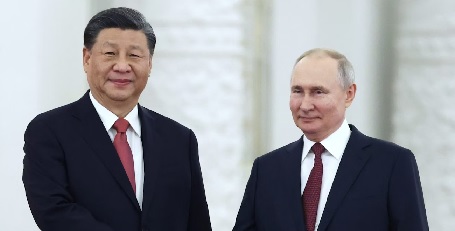
Some activists now want to see if the strategy can work to oust Russian president Vladimir Putin and end the war between Russia and Ukraine with a definitive victory for NATO’s Ukrainian proxy. A few hawks even advocate pursuing regime change in China.
In both cases, the strategy likely would prove catastrophic.
The love affair with regime change, whether through direct force or indirect destabilizing actions, has had a firm hold on the thinking of Western interventionists for a long time. As far back as 1953, the CIA worked with the British government to remove Iran’s democratically elected but sometimes uncooperative prime minister, Mohammad Mosaddegh, and restore the autocratic Shah to power. Washington’s targets throughout the international system over the decades number well into the double digits. Recent adversaries removed through direct or indirect American regime action include Iraq’s Saddam Hussein, Libya’s Muammar Gaddafi, and (just last year) Syria’s Bashar al-Assad.
As the Iran episode confirmed, dictators are not the only rulers put on Washington’s regime change hit list. Barack Obama’s administration aided—and perhaps even organized—the efforts of anti-government demonstrators to unseat Ukraine’s elected pro-Russia president, Viktor Yanukovych, in 2014.
American leaders regarded such regime change missions as great successes and have failed to learn two important lessons in the process. One is that apparent short-term successes frequently turn into longer-term fiascos. Getting rid of Gaddafi, for example, turned Libya into a cauldron of chaos where there were even credible reports of open-air slave markets for black African refugees. The overthrow of Mosaddegh ultimately helped pave the way to power for the current repressive Islamist regime and fostered an abiding hatred of the United States among many Iranians. Washington’s undermining of Yanukovych highlighted growing American contempt for Moscow’s view that Ukraine was crucial to Russia’s security. Repeated warnings from Putin and his associates that NATO’s continuing expansion toward Russia’s border, especially attempts to make Ukraine a NATO member or asset, would cross a bright red line went unheeded. The Kremlin’s subsequent military actions against Ukraine in turn led to the onset of a dangerous proxy war between NATO and Russia.
The other lesson that too many Western hawks have failed to learn is that even when regime change may prove feasible against relatively small, weak opponents, it will not work against larger, more powerful countries. Moreover, it is extraordinarily dangerous even to try such a coercive move. The risks include a vastly destructive war that could equal or even exceed the horrors of the two world wars. Nevertheless, reckless hawks indulge in regime-change fantasies with respect to both the People’s Republic of China (PRC) and Russia.
Although PRC officials remain suspicious of Washington’s long-term intentions, hardliners in the West focus more on strengthening Washington’s informal commitment to defend Taiwan than they think about fomenting regime change in the PRC itself. Even some of Beijing’s most aggressive opponents in America and its security partners in East Asia have concluded that seeking the overthrow of China’s communist government (however odious the regime might be) is a bridge too far.
It is imperative that American leaders avoid the temptation to pursue the objective of regime change in either China or Russia. Both powers are much more serious and capable geostrategic players than any of Washington’s previous targets. It is profoundly dangerous and unwise to equate such adversaries with the likes of Iran, Guatemala, Iraq, Yugoslavia, Libya, or Syria. Those countries were all second-tier or even third-tier military powers. Their ability to inflict damage on the American military was quite limited, although regime change in even those small, weak countries gave the American regime far more trouble than anticipated.
Russia and the PRC are full-fledged great powers capable of mounting very damaging diplomatic, economic, and even military countermoves against the United States. Most importantly both countries possess nuclear arsenals that could inflict enormous damage on the American homeland. The American regime has been able to overthrow adversarial regimes running much weaker countries, but it would be extremely dangerous, and quite possibly suicidal, to attempt the same strategy with respect to China or Russia. The American political and policy elites must abandon such irresponsible regime change fantasies.
 Hidden History -- In The Making