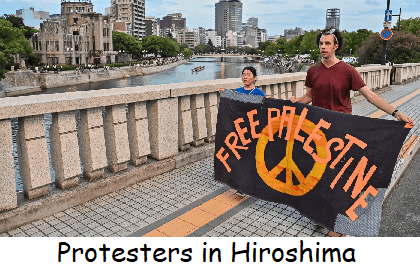
From Japan To Palestine, The Dehumanization Of The Victims Of American Imperialist Violence Has Enabled That Type Of Mass Killing To Be Repeated – And Rationalised.
On May 22nd 2025, the register of all victims of the American atomic bombing of Hiroshima was brought out from its stone-chamber cenotaph at Hiroshima Peace Memorial Park, following a silent prayer at 8.15am – the exact time the bomb fell on August 6th 1945, 80 years ago.
The register lists 344,306 names, with one volume dedicated to those whose identities are unknown. Marking the 80th anniversary, the city allowed media to view the inside of the chamber for the first time.
That very same day, as Hiroshima quietly marked its dead, Republican Congressman Randy Fine went on Fox News to suggest that a nuclear weapon be dropped on Gaza. Despite his history of incendiary and extremist remarks, he was not the first American politician to make such a statement.
A year earlier, on March 21st 2024, Republican Congressman Tim Walberg also suggested dropping a nuclear weapon on Gaza, “like Nagasaki and Hiroshima”.
The previous November, less than a month after Israel began its assault on October 7th 2023, heritage minister Amichay Eliyahu, of the Jewish Power Party, told a Hebrew radio station that a nuclear bomb should be dropped on Gaza.
Some Israeli commentators warned that calls to “nuke Gaza” risked drawing international outrage and undermining Israel’s long-standing policy of nuclear ambiguity – its refusal to confirm or deny possessing such weapons. After Prime Minister Benjamin Netanyahu suspended him from cabinet meetings and publicly disavowed the remarks, Eliyahu claimed his words were “metaphorical”.
Since Israel launched its genocidal war on Gaza, comparisons to the atomic bombings of Hiroshima and Nagasaki, which took place three days later on August 9th 1945, have been invoked by a range of figures.
The frequency and flippancy with which politicians and pundits have entertained – and at times encouraged – the nuclear destruction of Gaza has struck a nerve in Japan, where anti-war and pro-Palestine sentiment has surged.
The frequency and flippancy with which politicians and pundits have entertained – and at times encouraged – the nuclear destruction of Gaza has struck a nerve in Japan
Last year, Nihon Hidankyo, the group representing living atomic bomb survivors (hibakusha), won the Nobel Peace Prize. One of its leaders, Toshiyuki Mimaki, said aid workers in Gaza deserved the honour instead. Earlier that year, the mayor of Nagasaki refused to invite the Israeli ambassador to the city’s memorial, despite public criticism from Israel’s embassy and its supporters.
Japan’s pro-Palestine mobilisation has not been confined to civil society. In July 2025, Reiwa Shinsengumi, a five-year-old left-wing populist party led by former actor Taro Yamamoto, overtook the century-old Japanese Communist Party in the lower house and gained an additional seat in the upper house. Reiwa’s platform includes an explicit opposition to Zionism and support for Palestinian rights.
After nearly two years of a live-streamed genocide, the Japanese response carries a particular historical resonance.
In a country where the devastation of nuclear war is a living memory, casual calls to obliterate Gaza reflect the same logic of annihilation. That this recognition comes from survivors of mass destruction – who have stood publicly with Palestinians in Gaza – underscores not only the cruelty of such rhetoric, but the ease and impunity with which it is voiced.
Eighty years after Hiroshima, politicians’ open calls for the extermination of an entire civilian population – even as Palestinians are starved, bombed and incinerated – reveal how little has been learned, and how thoroughly such apocalyptic violence has been normalized.
 Hidden History -- In The Making