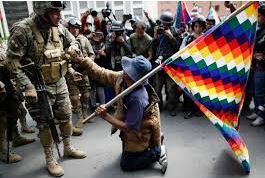
Morales was the glue that held everything together.
In 2005, I sat in a lounge off the Senate chamber in La Paz, Bolivia, waiting for an interview. I was wearing my best coat and tie. With my thinning hair and grey mustache, I could pass for a Bolivian of European descent. In fact, numerous people smiled and said “buenos días,” as if I was a familiar face.
The senators were mostly white men, reflecting the makeup of Bolivia’s political elite at that time. But that changed just a few months later with the election of Evo Morales and his party, Movement Toward Socialism (MAS).
Morales’s government nationalized natural gas and electric companies, defying both the US and the Bolivian oligarchy. So it’s not surprising that those forces now denounce Morales as a dictator and cheer his overthrow.
Bolivia held elections on October 20 this year. Opposition leaders, claiming vote fraud, organized mass, anti-government demonstrations. Sectors of the military and police sided with the opposition. Morales, his vice president and other top government leaders resigned under military pressure. Some went into exile in Mexico.
While the Trump Administration and mainstream media characterized the events as a popular uprising, Senator Bernie Sanders, Independent of Vermont, correctly called it a coup.
“It was the military who intervened in that process and asked him to leave,” Sanders said during the Democratic Party debate in Atlanta on November 20. “When the military intervenes, in my view, that’s called a coup.”
Some recent history:
In 2005, I reported from Bolivia on the popular movements opposed to then President Carlos Mesa. The rich elite who ran Bolivia in those days followed US-inspired neoliberal economic policies by privatizing government-owned companies, even those providing drinking water and sewage lines.
The privatized water utility was owned by a French multinational corporation. It raised the sewage hook-up charge to $450, roughly eight times the typical monthly income in El Alto, a working-class city located above La Paz.
The people of El Alto sought Mesa’s resignation through mass protests. “We used force because this is an issue facing us and our children,” street vendor Alejandra Arteaga told me when I was writing for the Dallas Morning News. “When there was a strike or a blockade, we went up to participate.”
In June 2005, a new round of mass demonstrations forced Mesa to resign, and by December, Bolivians elected Morales president. He served three terms.
Poverty alleviation and indigenous rights:
At a time when most Latin American economies were slowing, Bolivia under Morales and MAS reduced poverty by 42 percent and extreme poverty by 60 percent, according to a study by the Center for Economic and Policy Research (CEPR). In 2008, unemployment was cut in half, from 7.7 to 4.4 percent.
MAS made these advances because Bolivia defied conventional US economic prescriptions, according to Guillaume Long, a senior policy analyst at CEPR. “MAS opposed the neoliberal agenda and nationalized resources such as gas,” he told me in a phone interview.
The country’s indigenous groups, including Aymara and Quechua, saw significant gains under the MAS government, according to Bret Gustafson, an anthropology professor and Bolivia expert at the Washington University in St. Louis.
“The government passed anti-racism legislation,” he said in a phone interview. “Indigenous people were included in the highest level of the government and military. Indigenous languages and culture were celebrated under Evo.”
But those gains are in serious danger if the right wing stays in power.
Learn More At: http://www.informationclearinghouse.info/52648.htm
 Hidden History -- In The Making