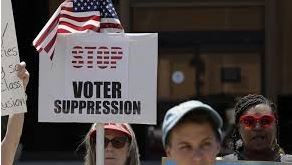
Such policies reflect a deep rooted thread of racism at the heart of American politics.
With next year’s presidential election drawing ever closer, and impeachment proceedings going forward against current leader Donald Trump, American citizens are facing existential questions about the nature of their democracy. The United States was founded on the promise of revolution – a war was fought and won on the rejection of the Old World’s hierarchical societies, and the glass ceilings that inhibited the freedom and progression of the non-ruling classes. America’s demonstrative patriotism is, in fact, often startling to outsiders. The pledge of allegiance, national anthem, and ubiquity of the flag build up a sense of American exceptionalism at the heart of public culture, fundamentally woven into daily life, and rooted in the belief that the nation offers a unique promise unmatched in other countries. Yet, the very ideals of democratic inclusion on which the United States celebrates itself is increasingly at risk. Despite the promise that all men are created equal – affirmed in the Declaration of Independence as the nation wrote itself into being – political maneuverings over the past few years reflect the sustained challenges of transforming that equality from an aspiration into a reality.
Reports and studies have suggested that there are significant voter suppression tactics occurring as we speak, with a noteworthy spike in efforts rising since Trump’s election in 2016. Such strategies are largely designed to shape electoral maps in favor of incumbent public officials and candidates running for the Republican Party. Some might argue that this is simply how politics works: those in power will do what they can to maintain it, and strategies such as gerrymandering are coeval with democracy itself. A closer examination of these techniques, and the populations they target, however, reveals the underlying biases that remain a fundamental impediment to genuine equality. Despite the promise of one person, one vote, recent efforts by the Republican Party have disproportionately sought to strip the right to vote from African Americans and people of colour (who typically vote for the Democrats) across the nation.
Such policies reflect a deep-rooted thread of racism at the heart of American politics – a wound that has festered since the nation shaped itself through slavery and, in academic George Lipsitz’s words, the possessive investment in whiteness as cultural capital. The systemic racism of disenfranchisement can be traced through America’s history: under slavery, the Constitution included a clause that valued black lives at the rate of ⅗ of whites’, adjusting population counts to increase the wealth and voting power of slaveholders. After the Civil War, Jim Crow legislation suppressed the supposedly liberated black vote by making voting near-impossible through segregation, violence, and prohibitive requirements. One of the outrages of the 2016 elections was the clarity with which such strategies have been resurrected. Georgia’s Democratic candidate Stacey Abrams amassed unprecedented success as an underdog, calling attention to the 1.5 million voters disenfranchised by her Republican competitor Brian Kemp. Despite a narrow loss, she has expanded her voter registration campaign nation-wide to encourage people of colour to participate in elections. In Florida, Democratic Gubernatorial candidate Andrew Gillum lead a successful campaign to restore voting rights to ex-felons – an outcome that enables over 1 million formerly disenfranchised people to vote, against a staggering near 18 per cent of the state’s black population who had been politically excluded. Indeed, while scholar Michelle Alexander defines the ‘new Jim Crow’ in response to the overwhelming incarceration of African Americans, there are clear links between this imprisonment and the desire among some policymakers to exclude the black population from public society.
Learn More At: http://www.informationclearinghouse.info/52612.htm
 Hidden History -- In The Making