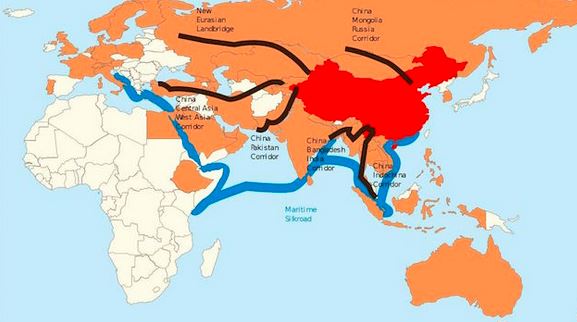
China’s New Silk Road is creating a multi-polar world, where all participants will benefit.
The Belt and Road Initiative (BRI), also called the New Silk Road, is based on a 2,100-year-old trade route between the Middle East and Eastern Asia, called the Silk Road. It wound its ways across the huge landmass Eurasia to the most eastern parts of China. It favored trading, based on the Taoist philosophy of harmony and peaceful coexistence – trading in the original sense of the term, an exchange with “win-win” outcomes, both partners benefit ting equally.
Today, in the western world we have lost this concept. The terms of trade are imposed always by the ‘stronger’ partner, the west versus the poorer south – the south where most of the natural resources are lodged. Mother Earth’s assets have been and are coveted by the west – or north – for building and maintaining a lifestyle in luxury, abundance and waste. This trend has lasted for centuries of western colonialism: Exploitation, loot, evisceration and rape of entire peoples of the Global South by the Global North, to use the current soothing World Bank lingo.
The New Silk Road, or BRI, is Chinese President Xi Jinping’s brainchild. It’s based on the same ancient principles, adjusted to the 21st Century, building bridges between peoples, exchanging goods, research, education, knowledge, cultural wisdom, peacefully, harmoniously and ‘win-win’ style. On 7 September 2013, Xi presented BRI at Kazakhstan’s Nazarbayev University. He spoke about “People-to-People Friendship and Creating a better Future”. He referred to the Ancient Silk Road of more than 2,100 years ago, that flourished during China’s Western Han Dynasty (206 BC to 24 AD).
President Xi’s vision may be shaping the world of the 21st Century. The Belt and Road Initiative is designed and modeled loosely according to the Ancient Silk Road. President Xi launched this ground-breaking project soon after assuming the Presidency in 2013. The endeavor’s idea is to connect the world with transport routes, infrastructure, industrial joint ventures, teaching and research institutions, cultural exchange and much more. Since 2017, enshrined in China’s Constitution, BRI has become the flagship for China’s foreign policy.
BRI is literally building bridges and connecting people of different continents and nations. The purpose of the New Silk Road is “to construct a unified large market and make full use of both international and domestic markets, through cultural exchange and integration, to enhance mutual understanding and trust of member nations, ending up in an innovative pattern with capital inflows, talent pool, and technology database”. BRI is a perfect vehicle for building peacefully a World Community with a Shared Future for Mankind – which was the theme of an international Forum held in Shanghai, from 5-7 November, a tribute to China’s 70th Anniversary of her Revolution and achievements – with a vision into the future.
BRI is a global development strategy adopted by the Chinese Government. Already today BRI has investments involving more than 150 countries and international organizations – and growing – in Asia, Africa, Europe, the Middle East and the Americas. BRI is a multitrillion investment scheme, for transport routes on land and sea, as well as construction of industrial and energy infrastructure and energy exploration – as well as trade among connected countries. Unlike WTO (World Trade Organization), BRI is encouraging nations to benefit from their comparative advantages, creating win-win situations. In essence, BRI is to develop mutual understanding and trust among member nations, allowing for free capital flows, a pool of experts and access to a BRI-based technology data base.
Learn More At: http://www.informationclearinghouse.info/52614.htm
 Hidden History -- In The Making